Imagine you are driving down the steep grades of the San Jacinto mountains toward Hemet, you tap the pedal to slow for a red light, and your steering wheel starts vibrating like a jackhammer. It is an unsettling feeling that immediately makes you wonder about your safety and your wallet. If you are asking, "why is my Honda shaking when I brake," you are not alone. With the average vehicle on U.S. roads now reaching a record high of 12.6 years, many of our neighbors are experiencing these same unnerving symptoms during their daily commute through the Inland Empire.
We understand that a vibrating car creates a lot of stress, especially when you are worried about brake failure or rising repair costs, which have increased 43.6 percent since 2019. This guide will help you discover the most common causes of brake vibration in your Honda and how to restore a smooth, safe ride on our local roads. We will look at how local heat-soak issues affect your rotors, explain industry cost averages like the $342 typical pad replacement per wheel, and help you decide if your car is safe for tomorrow's drive. At Diamond Valley Honda, we believe in providing the transparent information you need to feel empowered and secure behind the wheel.
Key Takeaways
- Learn to pinpoint whether the vibration is in your steering wheel or brake pedal to quickly identify the likely mechanical culprit.
- Understand why is my Honda shaking when I brake by exploring how the intense heat of the Inland Empire causes brake rotors to warp.
- Discover how worn suspension components or tire issues can mimic brake problems and why they require a professional diagnostic.
- Identify the long-term risks of ignoring a shaking vehicle, from increased stopping distances to permanent damage to your steering rack.
- See how utilizing factory-trained experts and Honda Genuine Parts ensures a precision repair that restores your peace of mind on the road.
Identifying the Shaking: Steering Wheel vs. Brake Pedal
When you notice a vibration while slowing down, the first thing our technicians ask is exactly where you feel the movement. Is it a shimmy in your hands, a thumping in your foot, or a rattle in your seat? Understanding the location of the shake is the most critical step in answering why is my Honda shaking when I brake. While many generic guides claim all vibrations are the same, the specific location provides a clear map to the mechanical failure. Pinpointing the source helps us determine if the issue is a simple maintenance item or a more complex safety concern.
Vibration in the Steering Wheel
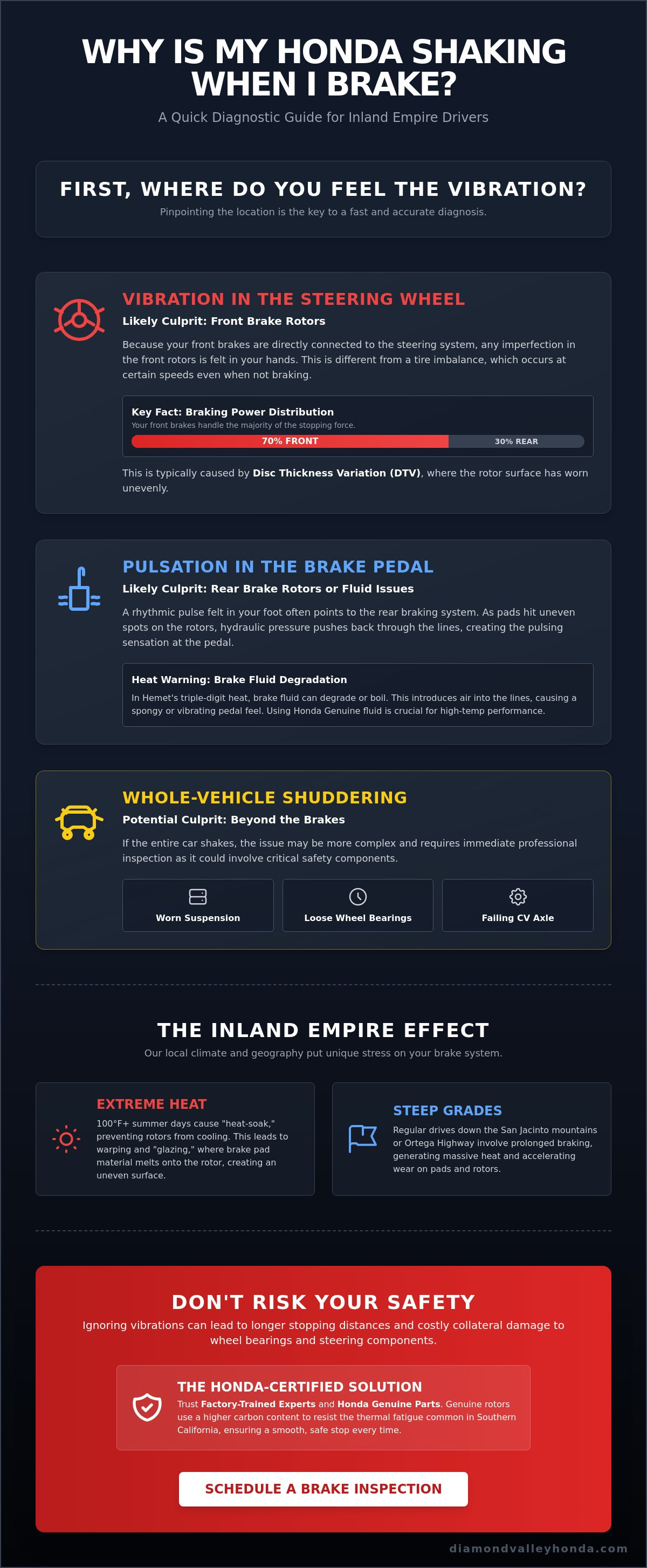
Your front brakes do about 70 percent of the work when stopping your car. Because the front rotors are connected to the steering knuckles and tie rods, any imperfection in the disc surface travels directly up the steering column and into your hands. This is often caused by Warped Brake Rotors, which are technically discs with uneven thickness. As the brake pads squeeze these uneven spots, they create a rhythmic kickback that vibrates the steering rack. You can differentiate this from a standard wheel imbalance because an imbalanced tire usually shakes at specific speeds, like 55 to 65 mph, regardless of whether you are touching the brake pedal. If the shake only appears when you apply pressure, the front rotors are the likely culprit.
Pulsation in the Brake Pedal
If you feel a rhythmic pulsing against the sole of your shoe, the issue often stems from the rear braking system. Rear rotors are smaller and can develop disc thickness variation over time. When the brake pads hit these high and low spots, the hydraulic fluid pushes back against the piston, sending a pulse through the lines to your footwell. During our triple-digit Hemet summers, brake fluid can reach extreme temperatures. If the fluid begins to degrade or boil under heavy use, it can cause a spongy or vibrating sensation that feels different than a mechanical warp. Using Honda Genuine Parts during a service ensures your system handles these local temperature extremes correctly without losing pedal feel.
Whole-Vehicle Shuddering
Sometimes the vibration isn't localized to one spot. If the entire cabin feels like it is shuddering, it may indicate that the problem has moved beyond the rotors. Worn suspension bushings can allow the control arms to oscillate when under the stress of braking. Loose wheel bearings or a failing CV axle can also manifest as a shake under deceleration. These issues are more complex and require a multi-point inspection to ensure your vehicle remains safe for your daily commute through the Inland Empire.
The Most Common Culprit: Warped Brake Rotors in the Inland Empire
Living in the Inland Empire means your vehicle faces environmental stressors that drivers in cooler climates never encounter. When you ask why is my Honda shaking when I brake, the answer is frequently tied to the "heat-soak" effect caused by our triple-digit summer days. Rotors are the heavy metal discs that spin with your wheels. Your brake pads clamp down on them to create the friction needed to stop. In Hemet, where temperatures often exceed 100°F, these metal components struggle to shed heat efficiently, making them vulnerable to physical distortion.
Why Honda Rotors Warp
Modern Honda models use precision-engineered rotors designed for a balance of weight and performance. However, repeated heavy braking leads to Disc Thickness Variation (DTV). This occurs when the rotor surface wears unevenly or when brake pad material transfers to the disc in "hotspots." This transfer, often called glazing, creates a slick, uneven surface that prevents smooth pad engagement. While aftermarket parts might save money upfront, they often lack the high-carbon content found in Honda Genuine Parts, which are specifically cast to resist the thermal fatigue common in Southern California. Following professional Diagnostic Steps for Hemet Drivers can help you determine if your rotors simply need resurfacing or a full replacement.
Local Factors: Heat and Hills
Geography plays a massive role in brake health for those of us in the Inland Empire. If you regularly commute down the steep descents from San Jacinto or navigate the winding turns of the Ortega Highway toward Temecula, your brakes are working overtime. Constant pressure on the pedal during a 3,000-foot elevation drop can cause rotors to glow red-hot. When you finally stop at a light with those scorching rotors, the pads act like a heat sink on one specific spot, causing the metal to expand and cool unevenly. This localized cooling is what leads to the warping that you feel as a vibration in your steering wheel.
To protect your vehicle, try using engine braking by shifting into a lower gear on long descents. This reduces the load on your braking system and helps prevent that dreaded steering wheel shake. If you are worried about the condition of your discs, our team can perform a multi-point inspection to check for signs of thermal stress and ensure your Honda remains safe for the road ahead.
Beyond the Brakes: Tires, Suspension, and Alignment Issues
While warped rotors are the most frequent answer to why is my Honda shaking when I brake, they aren't the only possibility. Sometimes the vibration originates in a completely different system and only reveals itself during the weight transfer that occurs when you slow down. When you apply the brakes, the front of your car dives slightly, putting maximum stress on your tires and suspension components. If these parts are compromised, they will chatter, shimmy, or shudder in a way that feels identical to a brake failure.
Tire and Wheel Health
Your tires are the only point of contact between your Honda and the Inland Empire pavement. If a tire has internal belt separation or "flat-spotting," it creates a rhythmic hop. This hop becomes much more pronounced as the vehicle's weight shifts forward during deceleration. Regular tire rotation and balancing is essential for commuters who spend hours every week on the I-15 or I-215. Without this maintenance, you might develop "cupped" tires. These are uneven wear patterns often caused by worn struts that allow the tire to bounce. This creates a persistent vibration that many drivers mistake for a rotor issue.
Suspension and Steering Linkages
Your Honda's suspension relies on a network of metal arms and rubber bushings to maintain stability. Control arm bushings act as cushions that hold the wheel in its proper position. When these rubber parts tear or dry out, the wheel can actually move forward and backward under the force of braking. This excessive play creates a violent shudder that travels through the entire chassis. Road conditions in Riverside County, including deep potholes and heat-damaged asphalt, accelerate the wear on these rubber components. A failing ball joint is an even more serious concern because it can make your steering feel erratic and loose. This leads many concerned owners to ask the NHTSA's most common question: Is It Safe to Drive? Any instability in your steering linkages means your car may not respond predictably in an emergency stop.
Alignment and Caliper Issues
Misaligned wheels don't just wear out your tread prematurely. They also put uneven pressure on your braking components. If your wheels are "toed out," they essentially fight against each other during deceleration, causing a jittery sensation in the steering wheel. Similarly, a sticking brake caliper can cause a constant pull or an intermittent shudder. Because these suspension and tire issues so closely mimic the symptoms of why is my Honda shaking when I brake, a professional multi-point inspection is the only way to ensure you aren't replacing parts that are still in good condition.
Is It Safe to Drive? Diagnostic Steps for Hemet Drivers
Safety is the most important factor when you start noticing a vibration during your commute. While some online forums might suggest "braking harder" to clean the rotors, this is dangerous advice that ignores potential mechanical failure. If you are asking why is my Honda shaking when I brake, you are actually feeling a warning sign from your vehicle's safety systems. A shaking brake system is significantly less effective during emergency maneuvers on the I-15. When the pads cannot make consistent contact with the rotor surface, your stopping distance increases. In a split-second situation, those extra feet can make a life-changing difference.
Ignoring these vibrations also leads to much higher repair bills down the road. The violent shaking doesn't stay localized to the brakes; it travels through the steering rack, tie rods, and suspension bushings. Since the average age of vehicles on U.S. roads is now 12.6 years, many older Hondas are already dealing with aged rubber components that can't handle this extra stress. Allowing the shake to continue can turn a simple rotor replacement into a full front-end rebuild.
Simple DIY Observations
You can perform a quick visual check at home without any tools. Peer through your wheel spokes at the brake rotors. If you see a distinct blue or dark tint on the metal surface, this is "blue-ing." It indicates the metal has reached extreme temperatures that have altered its structural integrity. You should also listen closely for high-pitched squealing or metal-on-metal grinding. If the shake only happens at highway speeds or under heavy pedal pressure, it helps our technicians narrow down the cause more quickly during your visit.
When to Call a Professional
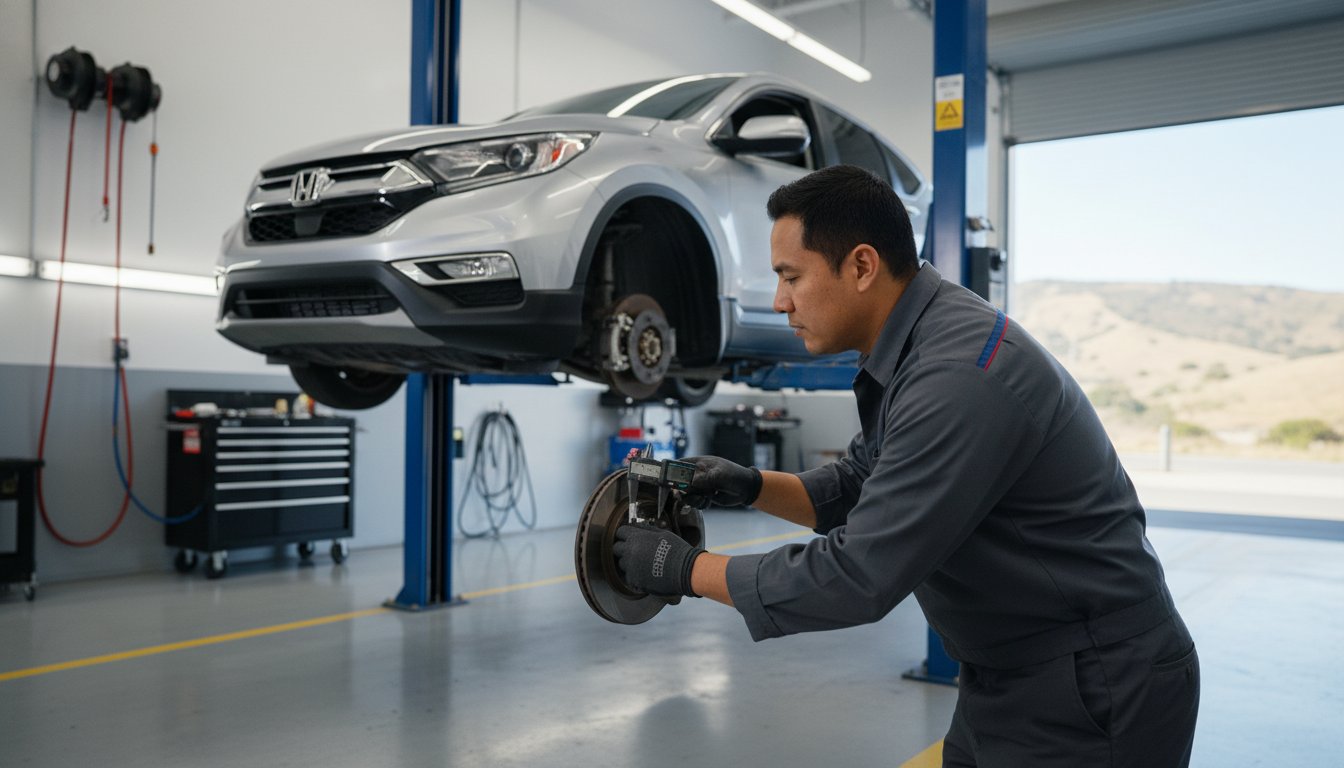
There are certain symptoms that require immediate attention. If your brake pedal feels "spongy" or sinks lower than usual, your hydraulic system may be failing. This is especially critical for Hemet drivers who frequent local mountain roads. Brake fade occurs when the system overheats to the point of losing all stopping power. This is a terrifying reality on steep descents if your components are already compromised. Scheduling a multi-point inspection allows our factory-trained experts to measure rotor thickness and check fluid health before a minor shake becomes a major safety risk.
Your peace of mind is our priority, and we want to ensure every mile you drive is a safe one. If your steering wheel is shimmying or your pedal is pulsing, don't wait for the problem to get worse. Schedule a professional brake diagnostic with our neighborly team today to restore your Honda's smooth, dependable performance.
Expert Brake Repair at Diamond Valley Honda: Restoring Your Peace of Mind
Resolving the mystery of why is my Honda shaking when I brake requires more than just a quick part swap. It demands a deep understanding of Honda’s specific engineering and the unique environmental pressures of the Inland Empire. At Diamond Valley Honda, our factory-trained technicians spend hundreds of hours studying the exact braking systems found in your Civic, CR-V, or Pilot. We don't just treat the symptom; we use state-of-the-art diagnostic equipment to measure rotor runout and check suspension tolerances to find the root cause. This precision ensures that once your car leaves our bay, the smooth, predictable stopping power you expect from a Honda is fully restored.
Quality matters when it comes to your safety. While some shops might use generic components to cut costs, we insist on Honda Genuine Parts. These components are designed specifically for your model's weight and performance specifications. They are cast from high-grade metals that resist the thermal fatigue caused by our local 100-degree days. By choosing parts engineered for your vehicle, you ensure a perfect fit and long-lasting durability that aftermarket alternatives simply cannot match. We also stay ahead of the curve by strictly following the latest California Bureau of Automotive Repair (BAR) standards, including the updated 2026 "Write It Right" guidelines, so you always receive a transparent and accurate estimate.
The Diamond Valley Difference
We believe that automotive service should be built on trust, not high-pressure sales tactics. Our technicians take the time to show you exactly what is happening with your vehicle, explaining the difference between simple pad wear and more complex rotor warping. We are proud to serve our neighbors in Hemet, Murrieta, and Temecula with a level of personal care you won't find at large corporate chains. While we work on your vehicle, you can enjoy our comfortable waiting area or take advantage of our local shuttle services to keep your day moving. It is this combination of world-class expertise and hometown values that defines our service center.
Schedule Your Service Today
Don't let a small vibration turn into a major safety concern or an expensive repair. Whether you are commuting from San Jacinto or Perris, we make it easy to get the expert care your vehicle deserves. You can use our simple online tool to Schedule your Honda brake service at Diamond Valley Honda at a time that fits your busy life. We frequently offer service specials for our local residents to ensure that maintaining your vehicle remains affordable and stress-free. Visit us today and experience the peace of mind that comes from knowing your Honda is in the hands of the Inland Empire’s most trusted experts.
Restore Your Smooth Ride and Safety Today
You now understand that answering why is my Honda shaking when I brake is the first step toward reclaiming your confidence on the road. Whether the issue is thermal warping from local mountain descents or worn suspension components, addressing these vibrations early prevents more costly repairs to your steering rack or tires. Our team has been serving the Inland Empire for years, providing the neighborly care and automotive expertise you deserve. We use only Genuine Honda OEM parts to ensure your vehicle meets the exact safety standards it had the day it left the factory.
Our factory-trained Honda technicians are ready to perform a precision diagnostic and get you back to a vibration-free commute. Don't let an unsettling shake compromise your peace of mind or your safety during the next Hemet summer. We are here to provide the transparent, dependable service you need to keep your Honda running at its best for miles to come.
Book Your Honda Brake Inspection in Hemet Today
Frequently Asked Questions
Can I drive my Honda if it's shaking when I brake?
You should not continue to drive your Honda if it exhibits a significant shake during braking. This vibration indicates that your braking system is not operating at peak efficiency, which can lead to increased stopping distances in an emergency. Over time, the constant shimmy can also cause premature wear on your steering rack and suspension bushings, turning a simple brake job into a much more expensive repair.
How much does it cost to fix a shaking car when braking in Hemet?
The total cost depends on whether your vehicle requires simple pad replacement, rotor resurfacing, or a full component swap. Industry data from March 2026 shows that the national average for brake pad replacement is approximately $342 per wheel, while rotor replacement averages around $613 per wheel. In California, labor rates for automotive technicians typically range between $155 and $200 per hour, reflecting a 43.6 percent increase in maintenance costs since 2019.
Will new brake pads stop my car from shaking?
New brake pads will rarely stop a vibration if the underlying cause is a warped rotor. If you are asking why is my Honda shaking when I brake, the issue is almost always the physical surface of the rotor rather than the pads themselves. Installing new pads on an uneven rotor will only cause the new pads to wear prematurely and will not restore a smooth ride.
How long do Honda brake rotors typically last in Southern California?
Honda brake rotors usually last between 30,000 and 70,000 miles, but our local environment often shortens this lifespan. The combination of 100-degree summer heat in Hemet and the steep grades of the San Jacinto mountains creates extreme thermal stress. This "heat-soak" can cause rotors to warp or reach their minimum thickness safety limits much faster than they would in flatter, cooler climates.
Why does my steering wheel shake only when I brake at high speeds?
High-speed shaking is typically the first sign of front rotor thickness variation. When you apply the brakes at 65 mph on the I-15, the system generates significantly more heat and friction than it does at city speeds. This amplifies any small imperfections in the rotor surface, sending a vibration through the steering column. It's a clear indicator that your front braking components need a professional inspection.
What is the difference between resurfacing and replacing rotors?
Resurfacing involves using a specialized lathe to shave off a thin layer of metal, creating a perfectly flat surface again. Replacement involves removing the old disc and installing a brand-new Honda Genuine Part. We only recommend resurfacing if the rotor still has enough "meat" to stay above the minimum thickness safety specifications required by the California Bureau of Automotive Repair.
Can an alignment issue cause my car to shake when I brake?
Yes, an alignment or suspension issue can often mimic the symptoms of a brake problem. When your wheels are misaligned, the weight transfer that occurs during deceleration can cause the tires to scrub or the suspension to oscillate. Because the average vehicle on the road is now 12.6 years old, many Hondas have aged bushings that allow for this extra movement during heavy braking.
Does Honda warranty cover warped brake rotors?
Warped rotors are generally considered wear-and-tear items and are not typically covered under the standard 3-year or 36,000-mile new vehicle limited warranty. However, if a component fails due to a verified manufacturing defect rather than heat-stress or normal use, it may be eligible for coverage. We recommend checking your specific vehicle service contract or visiting our service center for a definitive determination.