
Did you know that driving through a Hemet summer puts your car into the "severe" service category, even if your daily commute is just five miles? Most drivers feel a genuine sense of anxiety when a mystery light pops up on the dashboard or when they're unsure if a service quote is fair. You want to protect your investment without overpaying for things you don't need. We understand that frustration, and we're here to help you navigate it with confidence.
In this guide, you'll master the essential automotive maintenance tips needed to keep your vehicle reliable when the Inland Empire heat reaches 100 degrees for weeks at a time. We'll show you how our local climate impacts your engine fluids and battery life, which often drops by 30 percent in extreme heat. You'll learn to distinguish between standard and severe service schedules, identify simple DIY tasks, and know exactly when it's time to visit a professional. Let's ensure your car stays as dependable as a neighborly handshake.
Key Takeaways
- Learn how to implement professional automotive maintenance tips designed specifically to protect your vehicle against Hemet’s extreme 100°F+ summer heat.
- Discover why synthetic oil and high-grade coolant are essential for preventing boil-overs during steep Inland Empire climbs.
- Master the simple checks needed to manage tire pressure fluctuations caused by our local temperature swings and ensure your tread is road-ready.
- Find out why Hemet's intense UV rays and desert conditions threaten your battery and paint more than a cold winter ever would.
- See how leveraging the Honda Maintenance Minder system and factory-trained expertise provides a level of precision that general mechanics often miss.
Why Automotive Maintenance Tips Matter in Hemet and the Inland Empire
Keeping your vehicle in top shape in the San Jacinto Valley requires more than just an occasional car wash. For Hemet drivers, following professional automotive maintenance tips is a calculated financial strategy. Think of it as protecting your second largest investment from the unique environmental pressures of the Inland Empire. Preventive care isn't an inconvenience; it's a way to avoid the massive repair bills that often follow years of minor neglect. When you stay ahead of wear and tear, you're choosing the path of long-term savings and reliability.
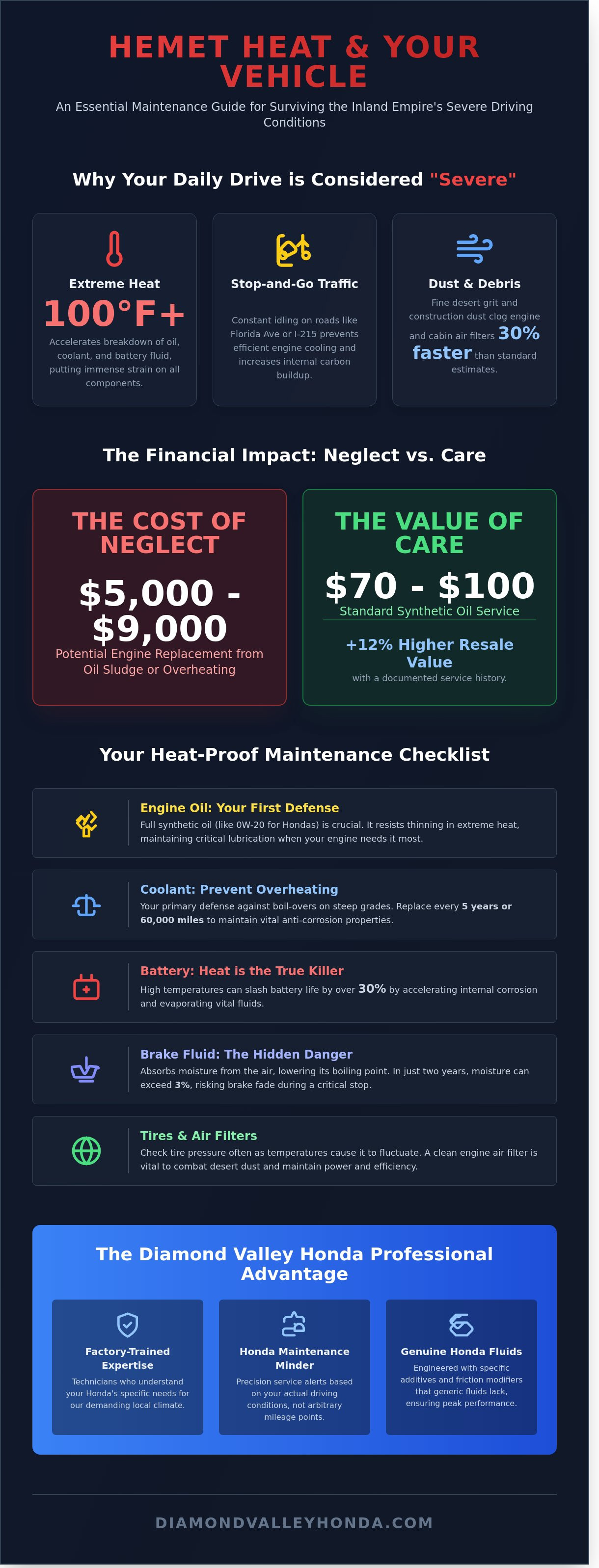
The local climate plays a massive role in how your vehicle ages. When summer temperatures regularly exceed 100°F, your car's cooling system and battery work twice as hard as they would in cooler coastal regions. Heat accelerates the chemical breakdown of vital fluids and puts immense strain on rubber components like belts and hoses. This environment, combined with the steep grades of Highway 74 and the heavy traffic on Highway 79, means your vehicle rarely operates under "normal" conditions. Maintenance is your first line of defense against being stranded on a desert road in July.
The Cost of Neglect vs. The Value of Service
A standard oil change and filter replacement costs roughly $70 to $100 at a certified facility. Compare that to the $5,000 or $9,000 price tag of a full engine replacement caused by oil sludge or overheating. Regular care ensures your car remains a reliable asset rather than a liability. In competitive markets like Menifee and Riverside, a documented history of motor vehicle service can increase your car's resale value by 12% or more. Beyond the money, there's the peace of mind that comes from knowing your car won't fail during your morning commute.
Defining 'Severe Conditions' for Riverside County Drivers
Many drivers assume they follow a "normal" maintenance schedule, but Riverside County's environment is demanding. Most local owner manuals actually classify our region under "severe conditions" due to several factors:
- Extreme Heat: Ambient temperatures over 100°F cause faster evaporation of coolant and break down the protective additives in your motor oil.
- Traffic Idling: Stop-and-go traffic on Florida Avenue or the I-215 prevents engines from cooling efficiently while increasing internal carbon buildup.
- Dust and Debris: Fine grit from local construction and Santa Ana winds can clog air filters 30% faster than the manufacturer's standard estimate.
Following targeted automotive maintenance tips helps you stay ahead of these local challenges. By acknowledging that Southern California driving is tough on machinery, you can take the necessary steps to ensure your Honda or other vehicle lasts for 200,000 miles and beyond.
The Essential Fluid and Filter Checklist for Peak Performance
Your vehicle's longevity depends heavily on the quality of the liquids and filters protecting its internal components. In Hemet, where summer temperatures regularly exceed 100 degrees for weeks at a time, your engine oil faces extreme thermal stress. These harsh conditions make automotive maintenance tips regarding synthetic oil particularly relevant. Full synthetic oil provides a higher viscosity index than conventional options, which prevents the oil from thinning out and losing its lubricating properties when you are idling in traffic on Florida Avenue. Most modern Honda engines perform best with a 0W-20 synthetic blend, designed to flow quickly during start-up while maintaining a protective barrier at high operating temperatures.
Coolant is your primary defense against the grueling climbs of the San Jacinto grade. As you gain elevation, your engine generates immense heat that must be dissipated through the radiator. If your antifreeze is older than five years or 60,000 miles, it likely lacks the chemical inhibitors needed to prevent internal corrosion. Similarly, brake fluid requires your attention. It is a hygroscopic fluid, meaning it naturally absorbs moisture from the air. Even in our dry climate, moisture levels in the fluid can rise over 3% in just two years, potentially leading to brake fade or component failure during a sudden stop.
Fluid Maintenance: Beyond Just Topping Off
Modern Honda Genuine Fluids are engineered with specific friction modifiers and anti-foaming agents that generic brands often lack. You should inspect your fluids monthly for changes in color and consistency; for instance, transmission fluid should be a bright pink or red, not a dark, burnt-smelling brown. While some manufacturers advertise "lifetime" fluids, these typically require a professional inspection every 30,000 miles to ensure they still meet factory specifications. If you aren't sure about your current levels, our technicians can provide a quick fluid health check to give you peace of mind.
Filter Health: Breathing Room for Your Engine
Hemet drivers face unique challenges with local dust from nearby agricultural fields and construction projects. Your engine air filter is the only thing stopping this grit from entering the combustion chamber, where it can act like sandpaper on your piston rings. Following EPA environmental driving tips by maintaining clean filters can improve your fuel economy by up to 10% while reducing tailpipe emissions. These automotive maintenance tips also apply to your cabin air filter, which traps pollen and local allergens before they reach your family's lungs. Genuine Honda air filters utilize a specific multi-fiber density that captures 99% of particles down to the 5-micron level, while many aftermarket options allow larger debris to pass through and damage sensitive sensors.
Tires, Brakes, and Suspension: Staying Grounded in Southern California
Hemet's unique climate puts specific stress on your vehicle that drivers in milder regions don't face. Our valley often sees diurnal temperature swings of 35 degrees between noon and midnight. These fluctuations cause your tire pressure to rise and fall, which can trigger your TPMS light or lead to uneven wear. Checking your pressure once a month ensures you don't compromise your fuel economy or safety. Proper inflation is one of the simplest automotive maintenance tips to follow, yet it saves you hundreds of dollars in premature tire replacement costs.
Tire Care for Longevity and Safety
Your tires are the only point of contact between your car and the road. We recommend a tire rotation every 5,000 to 7,500 miles to distribute wear evenly across all four corners. If you notice the inner or outer edges wearing faster than the center, your alignment is likely off. This often happens after hitting a deep pothole on the backroads of Perris or Banning. You should also watch for dry rot. The intense Southern California sun can cause sidewall cracking in tires as young as 4 or 5 years old, even if the tread looks deep. Use the "Penny Test" by inserting a penny into the groove with Lincoln's head upside down. If you can see the top of his head, your tread is below the safe 2/32-inch threshold and needs immediate attention.
Brake System Integrity
Stopping power is critical when you're descending from mountain communities like Idyllwild on Highway 74. Constant braking on steep grades leads to "brake fade," where heat buildup reduces friction and makes the pedal feel spongy. In the valley heat, rotors can reach temperatures exceeding 350 degrees, making them prone to warping if they're already thin. Listen for a high-pitched squeal; this is a built-in metal indicator telling you the pads have reached a thickness of 3mm or less. Following these automotive maintenance tips helps you avoid the dangerous vibration of warped rotors. We suggest a professional multi-point inspection every 6 months to check your brake lines for leaks and ensure your pads have sufficient life remaining.
Your suspension handles the heavy lifting on uneven local roads. Worn shocks or struts don't just make the ride bumpy; they increase your stopping distance by up to 20 percent. If your car "dives" forward during braking or feels unstable in the wind on the I-10, it's time for a checkup. Staying proactive with your suspension and alignment keeps your vehicle grounded and your family safe during every local commute. Our team at Diamond Valley Honda is here to help you identify these issues before they become expensive repairs.
Environmental Protection: Batteries and Exterior Care
Living in Hemet means dealing with extreme environmental conditions that test your vehicle's limits. While many drivers associate winter with car trouble, our 100-degree summers are actually more taxing on your vehicle's vital systems. These automotive maintenance tips focus on shielding your car from the relentless Inland Empire sun and the unique challenges of our local landscape.
The Science of Battery Failure in Heat
Most drivers think cold weather kills batteries, but heat is the silent culprit. High temperatures accelerate chemical reactions inside the casing, which causes the internal electrolyte solution to evaporate. This process leads to lead plate corrosion and can reduce a battery's effective lifespan by 20% in a single season. You should watch for a slow "whir-whir" sound when starting your engine. If your car takes more than 3 seconds to crank, your battery is likely struggling.
- Look for white, powdery buildup on the terminals.
- Check for a bloated or swollen battery case caused by extreme heat exposure.
- Test your battery's voltage; a healthy unit should read 12.6 volts when the engine is off.
A professional load test at Diamond Valley Honda identifies a failing cell before it strands you at the Diamond Valley Lake trailhead. It's a simple five-minute check that provides total peace of mind during a July heatwave.
Preserving Your Vehicle's Exterior
Hemet's UV index frequently reaches 10 or higher during the summer months. This intense radiation breaks down the molecular bonds in your car's clear coat, leading to oxidation and peeling. Applying a high-quality wax or ceramic coating every six months creates a sacrificial barrier against the sun. This layer also protects your paint from "desert sandblasting," which occurs when high winds kick up abrasive grit across the valley floor.
Don't forget the hidden areas of your car. If you take weekend trips to Idyllwild or Big Bear, wash your undercarriage immediately upon return. The road salt used on mountain passes can cause rust even in our dry climate. Additionally, inspect your rubber weatherstripping. Cracked seals let hot air into the cabin, forcing your A/C system to work 15% harder to maintain a cool temperature.
Clear visibility is another safety priority for rural Riverside County roads. Dry heat causes windshield wiper rubber to crack and streak within 90 days. You need them in top shape for sudden seasonal downpours. Similarly, yellowed, oxidized headlights can reduce your night vision by up to 70%. Restoring these lenses ensures you can spot hazards on Highway 74 or Highway 79 long before they become a problem. Following these automotive maintenance tips keeps your Honda looking and performing like new.
Schedule a professional multi-point inspection to ensure your battery and exterior are ready for the Hemet heat.
Professional Maintenance at Diamond Valley Honda: The Hemet Advantage
Choosing the right partner for your vehicle's care ensures that your automotive maintenance tips translate into long-term reliability. At Diamond Valley Honda, we utilize the Honda Maintenance Minder system to take the guesswork out of your service schedule. Unlike generic shops that rely on outdated mileage stickers, this onboard computer monitors your engine's operating conditions and Hemet's specific temperature fluctuations to calculate precise oil life. It ensures you aren't over-servicing your car or missing critical windows for fluid flushes and filter replacements.
Our factory-trained technicians possess specialized knowledge that general mechanics often lack. They spend over 100 hours annually in brand-specific training, allowing them to identify emerging issues in the 2026 Honda lineup before they become costly repairs. We exclusively use Genuine Honda Parts for every job. These components are engineered to the exact specifications of your vehicle, which is vital for maintaining your factory warranty and preserving the resale value of your investment. Using third-party parts can lead to compatibility issues, but our 100% genuine inventory guarantees a perfect fit every time.
The Diamond Valley Difference
We believe in transparency and neighborly service for every Inland Empire driver who walks through our doors. Our facility features advanced diagnostic tools specifically calibrated for the newest Honda models, ensuring we pinpoint issues with 98% accuracy on the first visit. While our experts work, you can enjoy our comfortable waiting lounge with complimentary Wi-Fi. If you have errands to run in Hemet, our local shuttle service covers a 15-mile radius, so your day doesn't stop just because your car is in the shop.
Taking the Next Step for Your Car's Health
Proactive care is the most effective way to save money over the life of your vehicle. We make it easy to stay on track by offering a rotating selection of service coupons and specials directly on our website. Our digital platform allows drivers from Murrieta and Temecula to book appointments in under 60 seconds. You can select your preferred day, time, and even your favorite service advisor with just a few clicks. Don't wait for a dashboard light to tell you there's a problem. Schedule your expert Honda service in Hemet today!
Drive With Confidence Across the Inland Empire
Maintaining your vehicle isn't just about today's commute; it's about protecting your investment for the next 100,000 miles. By following these automotive maintenance tips, you ensure your fluids stay clean and your tires maintain 100% of their necessary grip on Southern California roads. Our team at Diamond Valley Honda has served the Inland Empire for over 60 years, providing the local expertise your car deserves. We rely on Factory-Trained Technicians who understand every specific component of your vehicle, from the brake pads to the battery. We use 100% Genuine Honda Parts to guarantee a perfect fit and long-term reliability. Don't wait for a dashboard light to appear before taking action. A proactive approach saves Hemet drivers an average of $1,200 in avoidable repair costs over the life of the vehicle. You've worked hard for your car, and our neighborly service team is here to help you keep it in peak condition. Let's get you back on the road with total peace of mind.
Schedule Your Multi-Point Inspection at Diamond Valley Honda
Frequently Asked Questions
How often should I really change my oil in Hemet's heat?
You should change your oil every 5,000 miles if you frequently drive in Hemet's triple-digit summer temperatures. While some manuals suggest longer intervals, our local environment qualifies as severe driving conditions due to 100 degree heat and stop-and-go traffic on Florida Avenue. Following these automotive maintenance tips prevents oil thinning and protects your engine from premature wear. Our team uses genuine Honda synthetic oil to ensure your vehicle stays lubricated during the hottest July afternoons.
Why is my car battery only lasting two years in Southern California?
High temperatures in the San Jacinto Valley accelerate the internal corrosion and liquid evaporation inside your battery, typically shortening its lifespan to 24 or 36 months. Most batteries are designed for temperate climates, but our 95 degree average summer days act like a furnace under your hood. We recommend a battery load test every 6 months once your battery hits its second anniversary. This proactive step provides peace of mind and prevents unexpected breakdowns at the grocery store.
What are the most critical maintenance tasks for a high-mileage car?
You must prioritize timing belt replacement every 100,000 miles and transmission fluid exchanges every 30,000 miles to keep a high-mileage vehicle dependable. Neglecting a 300 dollar belt replacement can lead to 4,000 dollars in engine repairs if it snaps while driving. These specific automotive maintenance tips help your car reach the 200,000 mile mark without major mechanical failures. Our technicians specialize in extending the life of older vehicles through precise, factory-scheduled care and detailed inspections.
Does Diamond Valley Honda service non-Honda vehicles?
Yes, our service center maintains and repairs all makes and models, including Ford, Toyota, and Chevrolet. Our 25 service bays are equipped with the latest diagnostic tools to handle over 400 non-Honda vehicles every month for our Hemet neighbors. You get the same transparent pricing and professional expertise regardless of what badge is on your grille. We take pride in being a trusted local partner for every driver in our community, offering a neighborly experience that corporate chains can't match.
What does the 'Maintenance Minder' code A1 or B1 mean?
Code A1 indicates you need an oil change and a tire rotation, while code B1 signifies an oil change, tire rotation, and a mechanical safety inspection. The number 1 specifically alerts you that your tires require rotating to ensure even tread wear across all 4 wheels. We follow these 2024 factory protocols to ensure your vehicle remains efficient and safe. Our service advisors will walk you through the 31 point checklist included in a B1 service so you feel fully informed.
Can I do my own automotive maintenance and keep my warranty?
You can absolutely perform your own maintenance without voiding your New Vehicle Limited Warranty as long as you keep all 2024 parts receipts and a dated log. The Magnuson-Moss Warranty Act of 1975 protects your right to choose where and how your car is serviced. However, using genuine Honda parts from our department ensures your vehicle meets exact factory specifications. We offer a 12 month warranty on the parts we sell, giving you extra protection that generic auto parts stores don't provide.
How do I know if my tires are safe for a trip to the mountains?
Your tires are safe for a mountain climb if they have at least 6/32 inches of tread depth and no visible cracks in the sidewalls. Remember that tire pressure drops about 1 pound for every 10 degree decrease in temperature as you gain altitude toward Idyllwild. Check your spare tire pressure before you leave the valley floor to avoid being stranded on a narrow shoulder. We provide free tire pressure adjustments and tread depth measurements to ensure your family travels with total confidence.
What should be included in a standard multi-point inspection?
A professional multi-point inspection should cover 31 specific areas, including fluid levels, brake pad thickness, battery health, and tire condition. We use a simple green, yellow, and red color-coding system to show you exactly what is healthy and what needs attention soon. You'll receive a digital report that includes the specific measurement of your brake linings in millimeters. This level of transparency is known as the Diamond Valley Difference, ensuring you never pay for a repair that isn't necessary.