
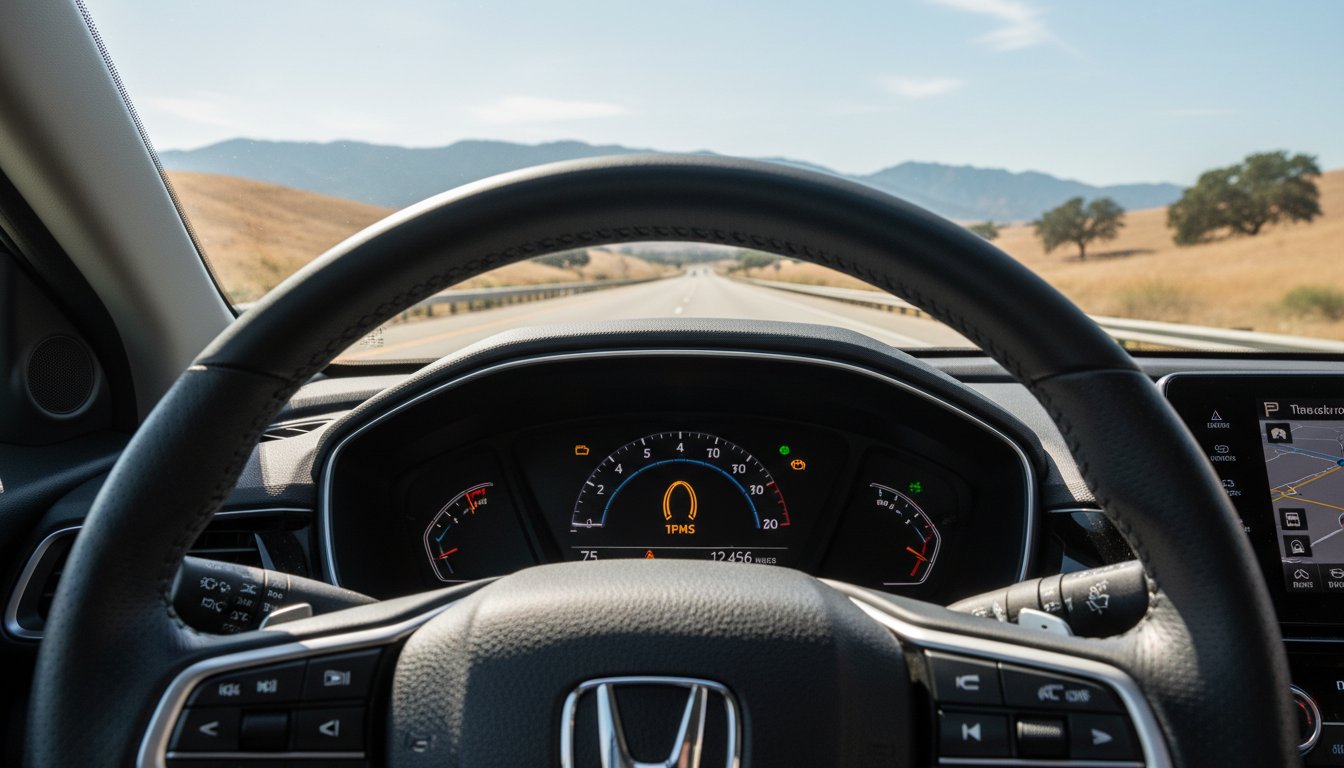
Last Tuesday, a Hemet driver named Sarah was cruising down the I-15 when a yellow, horseshoe-shaped icon suddenly illuminated her dashboard. It's a moment that causes instant anxiety for any Inland Empire commuter, especially when you're miles from the nearest exit on CA-74. You likely feel that same sense of annoyance when your tires look completely normal, yet the car insists there's a problem. It's hard to know if you're facing a genuine emergency or just a technical glitch.
This guide explains exactly what is tpms and why Southern California's frequent 30-degree temperature shifts often trigger these sensors. You'll learn the difference between a minor pressure drop and a dangerous puncture that requires immediate attention. We also provide clear steps to reset your system so you can drive with total peace of mind. We'll walk through the common causes for this alert and help you decide when it's time to visit our service center for a professional inspection. Our goal is to ensure you feel confident and safe every time you get behind the wheel.
Key Takeaways
- Understand exactly what is tpms and how this automated safety feature monitors your air pressure in real-time to prevent unexpected tire failure.
- Learn to distinguish between direct and indirect monitoring systems to better understand how your specific Honda model alerts you to pressure changes.
- Discover how Inland Empire weather and high-speed driving on the I-15 affect your tires and why a properly functioning system is your best defense.
- Master a simple five-step response plan for when your warning light comes on, ensuring you stay safe and avoid costly roadside emergencies in Hemet.
- Find out why specialized Honda diagnostics at Diamond Valley Honda offer more peace of mind than a general repair shop when troubleshooting sensor failures.
What is TPMS? Defining Your Tire Pressure Monitoring System
You're driving through the San Jacinto Valley when a yellow symbol suddenly glows on your dashboard. It looks like a horseshoe with an exclamation point in the center, but it's actually a cross-section of a tire. This is your Tire Pressure Monitoring System, commonly known as TPMS. At Diamond Valley Honda, we believe understanding what is tpms is essential for every driver in the Inland Empire. This automated safety feature uses sensors to monitor the air pressure inside your pneumatic tires in real-time. It's designed to be your first line of defense against a flat tire or a dangerous blowout.
The system has one primary job: it alerts you when at least one tire is under-inflated by 25% or more. While it doesn't replace regular maintenance, it provides a vital safety net. A Tire Pressure Monitoring System (TPMS) ensures you aren't guessing about your vehicle's health while commuting on the 215 or the 74. It's a reliable, high-tech guardian that stays active every second your engine is running.
The History of the TPMS Light
Before this technology became standard, drivers relied on the manual "kick the tire" method or a hand-held gauge to check for low air. This changed after the United States government passed the TREAD Act in 2000 following several high-profile accidents involving tire failures. The goal was simple: reduce the number of accidents caused by under-inflated tires. TPMS is a life-saving technology mandated for all vehicles manufactured after September 1, 2007. Since that date, every new car sold in Hemet has come equipped with this electronic safety system to protect you and your family.
Recognizing the Warning Signs on Your Dash
When you start your Honda at home in Hemet, you'll see the TPMS light illuminate briefly. This is a standard "bulb check" to prove the system is functioning. If the light stays on, it's telling you a specific story. A solid yellow light means at least one tire has dropped below the safe pressure threshold. However, if the light flashes for about 60 to 90 seconds and then stays lit, the system itself has a malfunction. This usually points to a dead sensor battery or a communication error that our technicians need to diagnose.
Sometimes the light might appear on a cold morning and disappear after you've driven a few miles. This happens because air contracts in the cold and expands as the tires heat up from friction. Even if it turns off, it's a signal that your pressure is borderline. Don't ignore these warnings. Knowing what is tpms and how it reacts to our local climate helps you stay ahead of potential roadside emergencies.
Direct vs. Indirect TPMS: How Your Honda Stays Alert
Understanding what is tpms depends entirely on which system your specific Honda model uses. While every system serves the same goal of keeping you safe, they achieve it through different methods. Some rely on physical hardware tucked away inside your tires, while others use clever software calculations. Knowing the difference helps you maintain your vehicle more effectively as you drive through the Inland Empire.The Mechanics of Direct TPMS
Direct TPMS utilizes a physical pressure sensor mounted on the inside of each wheel. These small devices measure the exact PSI within the tire and transmit that data via radio frequency signals to your car's onboard computer. Because these sensors are hardware-based, they rely on internal batteries that typically last between 5 and 10 years. When a battery dies, the entire sensor usually needs replacement. Our service team recommends using genuine Honda sensors for these replacements. This ensures the radio frequencies match your vehicle's specifications and provide 100% accurate data to your dashboard.How Indirect TPMS Works in Modern Hondas
Many newer Honda models now favor an indirect system. This approach is purely software-driven and does not use pressure sensors in the wheels. Instead, it monitors your Anti-lock Braking System (ABS) wheel speed sensors. The logic is simple: a tire with low air pressure has a smaller diameter, which causes it to spin at a different speed than a properly inflated tire. Drivers in San Jacinto and Menifee often prefer this system because it has fewer physical parts that can fail or break during a tire change. You can learn more about the federal standards for these systems by visiting NHTSA's TireWise safety information. When using an indirect system, keep these points in mind:- You must "recalibrate" the system through your vehicle's settings menu after adding air or rotating tires.
- The system requires about 20 minutes of driving at speeds between 30 and 60 mph to finish its initial learning process.
- It is highly reliable because it avoids the common battery and corrosion issues found in physical sensors.
Why the TPMS Light Matters for Inland Empire Drivers
Your TPMS light isn't just a suggestion; it's a vital safety tool for navigating the unique terrain of the Inland Empire. Understanding what is tpms helps you realize that your tire pressure is a moving target. It shifts constantly based on how fast you drive and the environment around you. When you're cruising at 70 mph on the I-15, properly inflated tires are your first line of defense against dangerous blowouts. High speeds generate heat, and if your tires are already under-inflated, the risk of structural failure increases significantly.
Safety is the priority, but your wallet benefits too. Low pressure creates extra rolling resistance, which forces your engine to work harder. This inefficiency drains your tank faster at the Hemet gas pump, costing you more every week. According to the NHTSA TireWise program, maintaining the right pressure can improve your fuel economy by up to 3%. You'll also see more life from your tires. Correct inflation prevents the uneven tread wear that often forces local drivers to replace a set 10,000 miles earlier than necessary. Keeping that light off means keeping more money in your pocket.
The Impact of Hemet’s Temperature Swings
Hemet and Beaumont experience massive daily temperature shifts that directly affect what is tpms readings. You should follow the 10-degree rule, which states that tire pressure changes by approximately 1 PSI for every 10 degrees of temperature change. It's common for your light to glow during a 45-degree morning in Beaumont, only to vanish when the afternoon sun hits 85 degrees. As we transition from 100-degree summer days to chilly winter nights, you must manually check and adjust your pressure to ensure your sensors stay accurate and your tires stay protected.
Road Conditions in Riverside County
The roads in Riverside County aren't always kind to your vehicle. Hitting a deep pothole can damage your tire seals or even jar the sensor itself, leading to false readings or air leaks. If your wheels are knocked out of alignment, it creates uneven heat distribution across the tire, which can trigger a TPMS warning. If you've hit a curb or a major road defect recently, schedule a Wheel Alignment Service. This keeps your TPMS system, your tires, and your suspension in perfect sync for a smoother ride.
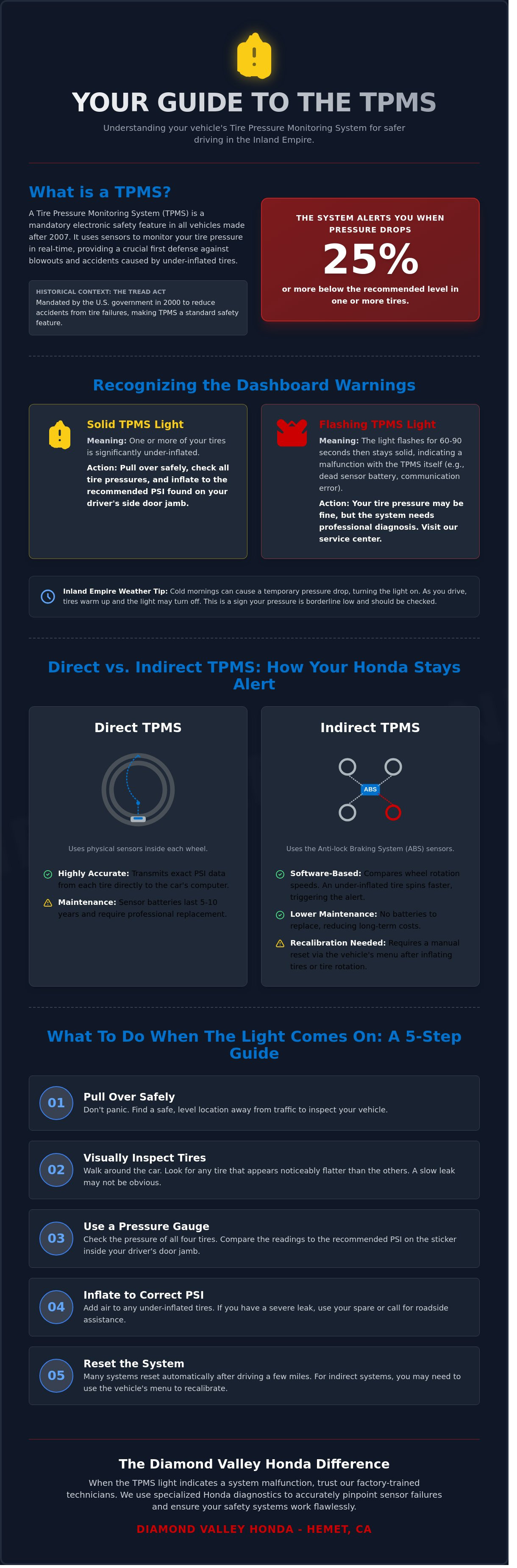
What to Do When the TPMS Light Illuminates: A 5-Step Guide
Seeing that yellow horseshoe icon pop up while you're driving down Florida Avenue can be a bit startling. Don't panic. Understanding what is tpms means knowing it's simply a helpful alert designed to keep you safe on Inland Empire roads. Follow these five steps to handle the situation like a pro.
- Step 1: Find a safe, level spot to pull over. Inspect your tires for visible nails, gashes, or a "flat" appearance.
- Step 2: Use a manual tire pressure gauge. This tool provides a more precise reading than the digital sensors in your wheels.
- Step 3: Match your tires to the correct PSI. Check each tire against the numbers listed on your driver-side door jamb.
- Step 4: Calibrate the system. Use your Honda's interface to tell the computer you've corrected the pressure.
- Step 5: Watch for flashing. If the light blinks for 60 to 90 seconds before staying solid, your sensor might be broken.
Checking Your PSI Like a Pro
Precision matters for tire longevity. You'll find a white and yellow sticker on your driver-side door frame that lists the exact PSI for your front and rear tires, often between 32 and 35 PSI. Always check your pressure when the tires are "cold." This means the car has been parked for at least three hours or driven less than one mile. When you understand what is tpms and how it reacts to temperature, you can avoid unnecessary trips to the shop. While many gas stations in Hemet offer air pumps, their built-in gauges are often inaccurate. Invest $10 in a personal digital gauge for your glovebox to ensure your safety.
Resetting the System in Your Honda
Newer Honda models use an indirect system that requires a manual reset. You can usually find the "TPMS Calibration" option through your steering wheel buttons or the "Settings" menu on your infotainment screen. Once you select "Calibrate," you need to drive at speeds between 30 and 65 mph for approximately 20 to 30 minutes. This allows the system to learn the new tire diameters. If the light stays on after this drive, it's time to visit the Honda Service Center Hemet for a professional diagnostic check.
Don't let a tire light ruin your commute. Schedule your professional tire inspection with our expert team today to stay safe on the road.
The Diamond Valley Honda Difference: Expert TPMS Care in Hemet
Understanding what is tpms is only half the battle; knowing who to trust when that yellow light flickers is the other. While general repair shops often use universal scanners, Diamond Valley Honda utilizes genuine Honda diagnostic software designed specifically for your vehicle's onboard computer. This precision allows our team to distinguish between a simple pressure drop caused by a 10-degree temperature shift and a failing sensor battery that requires replacement. We believe in total transparency. If your tires just need a quick top-off of air, we'll handle it and get you back on the road without unnecessary upselling.
Our location in Hemet serves as a central hub for drivers throughout the Inland Empire. Whether you're commuting from Menifee, Perris, or Temecula, our service center provides a reliable alternative to impersonal corporate chains. We've served the community for years, building a reputation on honest advice and efficient repairs. You won't find high-pressure tactics here; just expert technicians dedicated to keeping your family safe on the road. We treat every vehicle as if it were our own, ensuring your tire pressure monitoring system is functioning exactly as the factory intended.
Factory-Trained Technicians You Can Trust
Honda vehicles like the Pilot, Accord, and CR-V have unique TPMS configurations that require specialized knowledge. Our factory-trained technicians undergo hundreds of hours of brand-specific training to master these nuances. Every tire service includes a comprehensive multi-point inspection. We don't just look at the sensor; we check your tread depth and sidewall integrity to ensure 100% road readiness. This neighborly approach ensures that every driver leaves our lot feeling confident. We take pride in being a trusted local partner for Inland Empire motorists.
Schedule Your Tire Service Today
Don't let a dashboard light cause unnecessary stress during your commute. Visit us for a rapid pressure check or a full sensor diagnostic. While our experts work, you can relax in our comfortable waiting area or browse our genuine Honda parts department. We maintain a full inventory of OEM sensors to ensure your repair is completed correctly the first time. Your safety is our priority, and we're ready to help you maintain it. Schedule your Honda service in Hemet today and experience the Diamond Valley difference for yourself.
Drive With Confidence Across the Inland Empire
Understanding what is tpms ensures you stay safe while navigating Highway 74 or commuting through Riverside County. Your tire pressure monitoring system acts as a constant guardian for your fuel economy and tire longevity. When that amber dashboard light flickers on, it's a vital signal to protect your vehicle's performance and your family's safety. Ignoring these alerts can lead to decreased traction and increased wear on your tires.
Our team at Diamond Valley Honda has served Inland Empire drivers for over 15 years with a commitment to transparent, reliable service. We utilize 100% Genuine Honda Parts and Accessories to ensure every repair meets strict factory specifications. You can trust our staff of 12 factory-trained Honda technicians to diagnose sensor issues or pressure drops with absolute precision. We've built our reputation on being your dependable local partner, providing the peace of mind you deserve every time you turn the key. Don't let a warning light linger and compromise your daily drive.
Schedule Your Honda Tire Service in Hemet
We look forward to seeing you at the dealership and keeping your Honda in peak condition for many miles ahead.
Frequently Asked Questions
Is it safe to drive with the TPMS light on?
No, it's not safe to continue driving long distances when the light stays illuminated. This warning indicates that at least one of your tires has dropped 25 percent below its recommended inflation level. Low pressure significantly increases your braking distance and creates excess heat; this can lead to a dangerous blowout while you're traveling on Highway 74 or the I-15.
How do I reset my TPMS light after putting air in the tires?
You can usually reset the system by driving your vehicle at 40 mph for at least 10 minutes. If the light remains on, check for a physical reset button located under the steering wheel or navigate through your Honda's infotainment settings menu. Understanding what is tpms and how to calibrate it ensures your vehicle accurately monitors the 32 to 35 PSI required for most local commutes.
Why does my TPMS light come on when it gets cold in the morning?
Your light activates because tire pressure typically drops by 1 PSI for every 10 degree decrease in the outside temperature. During a crisp Hemet morning where the thermometer hits 45 degrees, your tires lose enough air density to trigger the sensor. The light often turns off on its own after you drive for 5 miles, as the friction against the road warms the air back up.
Can a dead battery in the sensor cause the TPMS light to flash?
Yes, a failing internal battery is the primary reason an indicator light begins to flash. These specialized lithium-ion batteries are designed to last between 5 and 10 years, or roughly 100,000 miles of driving. Because the batteries are permanently sealed inside the sensor housing, you'll need to replace the entire unit once the power level drops below the functional threshold.
Does my spare tire have a TPMS sensor?
Most compact spare tires don't include a sensor, though full-size spares in larger SUVs and trucks often do. If you're currently driving on a "donut" spare, the dashboard light will likely stay on because the computer can't find a signal from that wheel. You can verify if your specific model monitors the 5th wheel by checking the technical specifications in your owner's manual.
How much does it cost to replace a TPMS sensor in Hemet?
You should expect to pay between $50 and $150 per sensor for parts and professional labor at a local service center. This price range depends on your specific vehicle year and whether you opt for genuine OEM parts. At Diamond Valley Honda, our certified technicians can usually complete a single sensor replacement in about 30 minutes to provide you with immediate peace of mind.
What is the difference between a solid TPMS light and a blinking one?
A solid light indicates that your tire pressure is low, while a blinking light signals a malfunction within the system itself. If the icon flashes for 60 to 90 seconds before staying solid, the sensor or the receiver has likely failed. Recognizing this difference is a vital part of knowing what is tpms so you can tell if you need a simple air refill or a technical repair.