Picture yourself at 5:15 PM on a Tuesday, inching along West Florida Avenue toward Winchester Road. If you are debating the merits of a manual vs automatic vehicle, your left leg likely feels the difference after the tenth stop-and-go cycle in under ten minutes. Many Hemet drivers wonder if the classic control of a stick shift is still worth the physical effort in 2026 traffic conditions. You're right to be cautious about your choice. While over 98 percent of new vehicles now come with automatic gearboxes, the questions regarding fuel economy and long-term repair costs are more complex than ever.
We believe you deserve a vehicle that fits your daily commute without breaking your budget. You will discover the real-world performance data for Inland Empire roads and see how modern engineering has narrowed the gap between these two options. We'll break down the maintenance schedules and efficiency ratings so you can make a confident decision for your next Honda. Here is everything you need to know before you visit us for a test drive at Diamond Valley Honda.
Key Takeaways
- Determine whether a manual or automatic offers the best long-term value and fuel economy for your specific Inland Empire driving habits.
- Understand how local terrain-from the stop-and-go traffic on Florida Avenue to the steep San Jacinto mountain climbs-impacts your daily driving experience.
- Compare the maintenance requirements of manual vs automatic gearboxes to ensure your Honda stays dependable and budget-friendly for years to come.
- Identify which transmission type aligns with your lifestyle, whether you prioritize driver engagement or seamless commuting through the I-215.
- Learn about the versatile paddle-shifting options available at Diamond Valley Honda that provide the perfect balance of control and modern convenience.
Understanding the Basics: Manual vs. Automatic in the Inland Empire
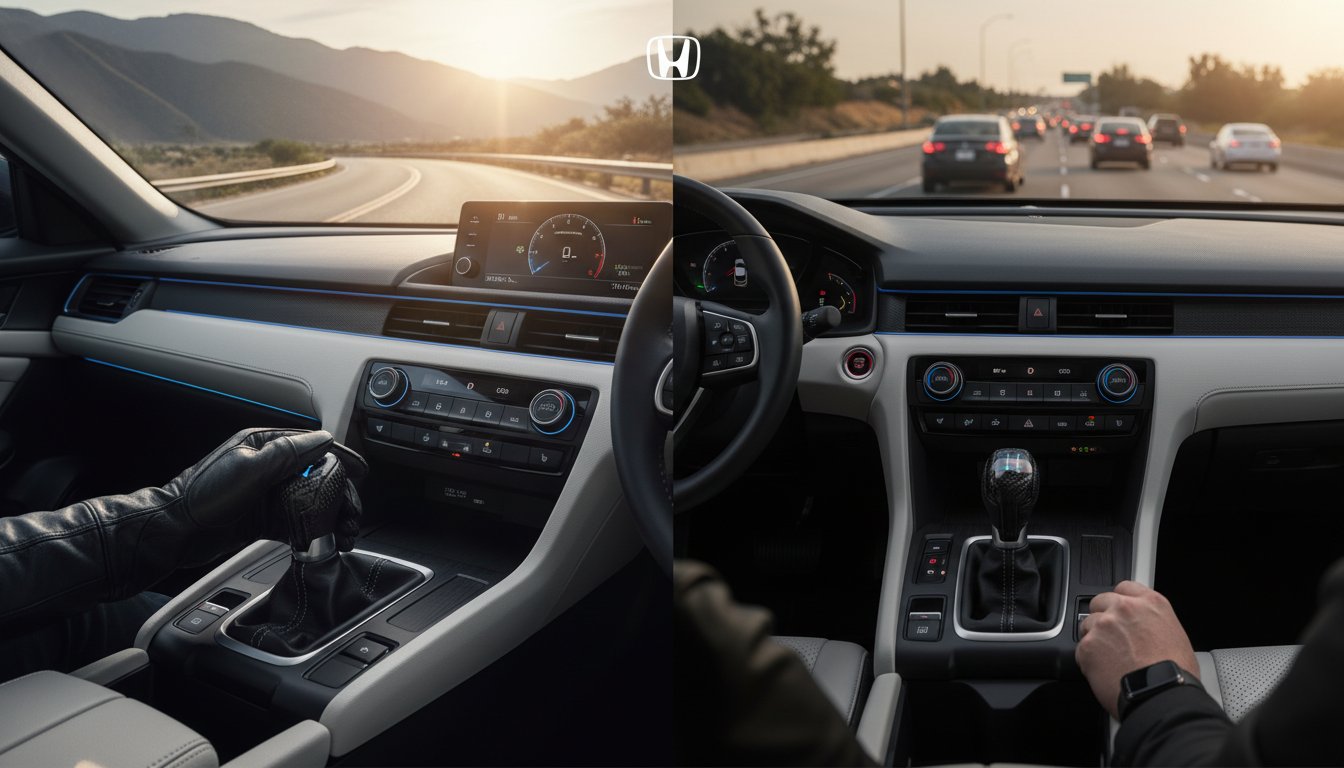
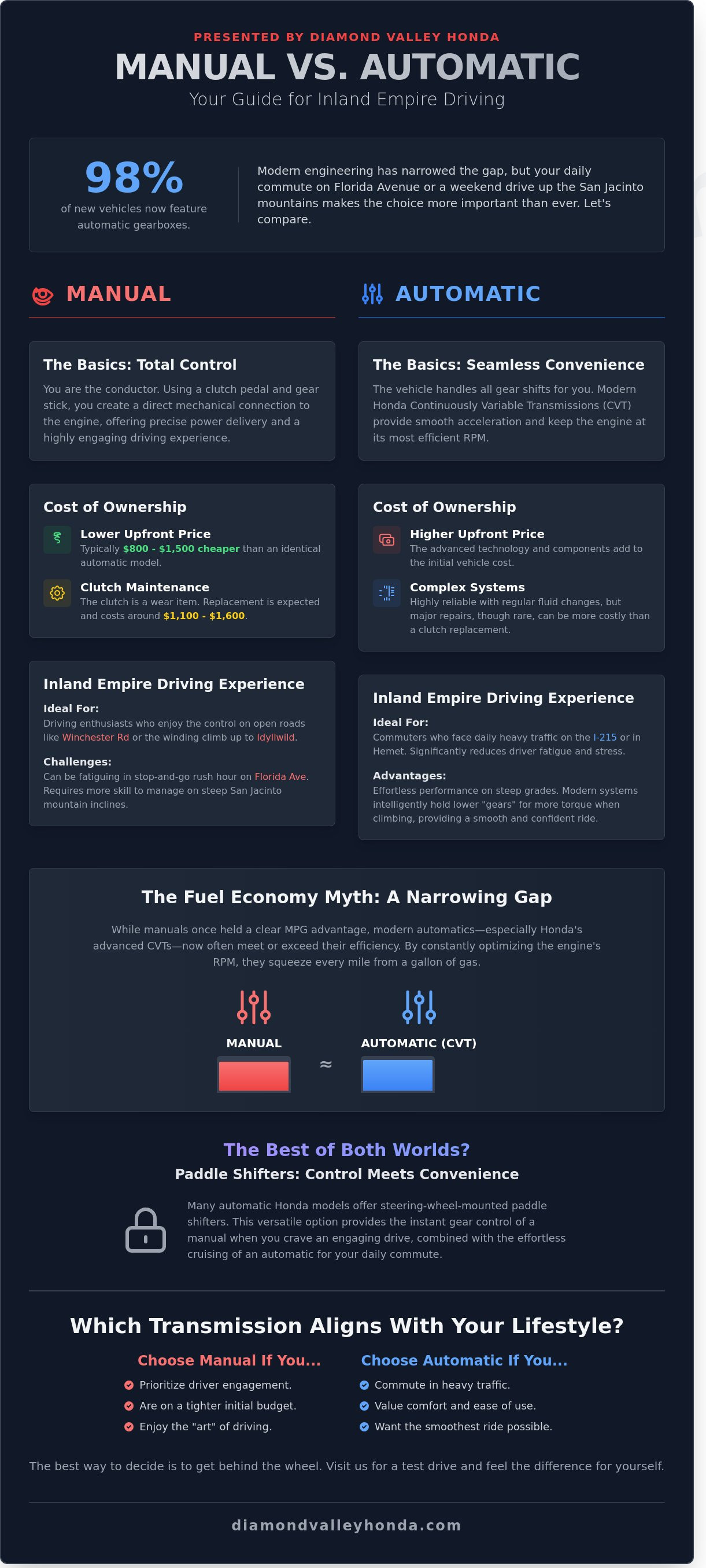
Choosing between manual vs automatic transmissions is one of the first decisions you'll face when visiting Diamond Valley Honda. This choice defines your daily interaction with your vehicle, especially when navigating the unique geography of the San Jacinto Valley. A manual transmission represents the traditional, driver-centric approach. It requires you to use a floor-mounted gear stick and a floor-mounted clutch pedal to navigate through the gears. In contrast, an automatic transmission is a computer-controlled system that handles the shifting for you. Most 2024 Honda models now feature these seamless systems to prioritize ease of use and fuel efficiency.
In Hemet, this decision carries extra weight. Our local roads range from the stop-and-go congestion on Florida Avenue to the steady inclines of State Route 74. During the afternoon rush, traffic delays on major Hemet thoroughfares can increase travel times by 25 percent. If you spend 45 minutes a day in heavy traffic, the physical act of shifting gears hundreds of times becomes a major factor in your driving comfort. At Diamond Valley Honda, we focus on the "Diamond Valley Honda Difference" by helping you weigh these local realities against your personal driving style. We don't just sell cars; we ensure your transmission choice aligns with your life in the Inland Empire.
How a Manual Gearbox Works
A manual gearbox puts you in total control of the vehicle's power delivery. You use the clutch pedal to temporarily disconnect the engine from the transmission so you can select a new gear. Many driving enthusiasts in Hemet still crave this mechanical connection because it allows for precise timing during gear changes. It provides a level of engagement that many find rewarding on open stretches of Winchester Road. Clutch engagement is the physical link between engine and wheels. Mastering this connection allows you to downshift for extra power or upshift early to save fuel, giving you a level of influence that computers can't always replicate.
The Evolution of the Automatic Transmission
Automatic technology has evolved significantly since its mass-market debut in 1939. To appreciate the modern driving experience, it helps to understand how automatic transmissions work and how they have moved beyond traditional torque converters. Today, many Honda models utilize Continuously Variable Transmissions (CVTs). These systems don't have fixed gears; instead, they use a belt and pulley system to provide an infinite range of ratios. This ensures the engine always operates at its most efficient RPM, which is vital for maintaining high MPG during long commutes to Riverside or Temecula.
Modern Honda automatics are also smarter than their predecessors. They use adaptive software to learn your driving habits. If the system detects you are climbing a steep grade toward Idyllwild, it will hold a lower gear to provide more torque. Additionally, the rise of "Shift-by-Wire" technology in newer models like the Accord Hybrid replaces the traditional mechanical lever with electronic buttons. This innovation saves space in the cabin and reduces the mechanical complexity of the shifting process. When comparing manual vs automatic options, these modern conveniences often win over drivers who value a stress-free experience in heavy Southern California traffic.
- Manual: Best for those seeking a tactile, engaging driving experience.
- Automatic: Ideal for commuters facing daily Hemet traffic congestion.
- CVT: A Honda specialty that maximizes fuel economy and smoothness.
The Cost of Ownership: Upfront Price vs. Long-Term Value
Deciding between manual vs automatic starts with your wallet, but the math has changed over the last 10 years. In the used car market around Hemet, a manual vehicle often carries a sticker price $800 to $1,500 lower than an identical automatic model. This upfront savings appeals to budget-conscious drivers, yet the total cost of ownership involves a deeper look at fuel, insurance, and eventual resale. Choosing between manual vs automatic for your next vehicle requires balancing that initial discount against the daily realities of Southern California driving.
Maintenance costs also factor into your long-term value equation. We often see customers who believe a manual will save them thousands in repairs. While it's true that manual gearboxes are mechanically simpler, the clutch is a wear item that eventually needs attention. Replacing a clutch in a modern vehicle usually costs between $1,100 and $1,600. In contrast, an automatic requires regular fluid flushes every 30,000 to 60,000 miles, costing roughly $250 each time. Over 100,000 miles of driving through the San Jacinto Valley, these maintenance costs often balance each other out.
Fuel Efficiency: Dispelling the Manual Myth
The old rule said manuals get better gas mileage. Modern engineering has flipped that script. Honda CVTs (Continuously Variable Transmissions) now use advanced belt and pulley systems to stay in the power band's sweet spot constantly. For example, a 2024 Honda Civic with a CVT achieves an EPA-estimated 33 city / 42 highway MPG. The manual version of the same car often sees a 10% to 15% drop in efficiency, particularly in the stop-and-go traffic found on Florida Avenue. Automatic start-stop technology also plays a role. It saves roughly 5% of fuel by cutting the engine during long waits at red lights, a feature rarely found on manual gearboxes. Gear ratios also impact your daily drive. Modern 10-speed automatics allow for very low RPMs while cruising at 70 MPH on Highway 74, reducing engine wear and cabin noise compared to the shorter gears found in most sticks.
Insurance and Resale Considerations
Insurance premiums in Riverside County depend more on your driving record and the vehicle's safety rating than the transmission type. Interestingly, recent safety studies have examined how different vehicle types impact driver focus and accident severity, proving that modern safety suites are the real priority for insurers. You won't typically see a rate hike just for choosing a stick shift. On the resale side, manuals occupy a unique space in Southern California. While 96% of drivers prefer automatics, the remaining 4% are often enthusiasts willing to pay a premium for a well-maintained manual Honda.
This niche demand means a manual Civic Si or Type R might hold 12% more of its value compared to standard commuter models after five years. At Diamond Valley Honda, we use real-time market data to evaluate every trade-in, ensuring you receive a transparent offer that reflects your car's specific configuration. If you're curious about how your current ride stacks up, you can value your trade online with us today. We believe in providing clear, functional information so you feel empowered in your decision.
Driving Experience: Navigating Hemet Traffic and Local Terrain
Driving through Hemet requires a vehicle that can handle a specific mix of suburban congestion and steep elevation changes. When deciding between a manual vs automatic transmission, you must consider your daily route. If your morning starts on Florida Avenue, you know the rhythm. It's a cycle of red lights and sudden stops. In a manual vehicle, this means your left leg is constantly working. Drivers often experience "clutch leg" fatigue during the 45 minute crawl toward the I-215. Modern automatic transmissions eliminate this physical strain, allowing you to focus on the road instead of your footwork.
Taming the Inland Empire Commute
The daily commute through Menifee and Perris has changed significantly over the last 10 years. Traffic volume on the I-215 has increased by nearly 25% since 2014, making stop-and-go conditions the new normal. For these drivers, automatics win the day. Many new Honda models feature Low Speed Follow. This system maintains a set interval behind the car in front of you and can even bring your vehicle to a complete stop. It takes the stress out of the Inland Empire grind. Manual drivers can manage this traffic by leaving extra space to avoid constant shifting, but it's a demanding task that requires constant attention to avoid burning the clutch. Beyond the physical effort, there are various costs to consider when evaluating how stop-and-go driving impacts your transmission's lifespan and maintenance schedule.
Performance on the Ortega Highway and Mountain Roads
While automatics offer ease, the San Jacinto mountains and the San Gorgonio Pass tell a different story. If you enjoy weekend trips to the Temecula wineries or drives up the Ortega Highway, a manual transmission offers a level of engagement an automatic cannot match. You get total control over gear selection, which is vital for hitting the apex of a sharp curve. Downshifting into a lower gear on a 6% grade allows the engine to naturally regulate your speed, reducing the heat load on your brake rotors and preventing brake fade. This precision provides a sense of connection to the road that many enthusiasts crave.
Choosing a manual vs automatic involves a trade-off between the fun factor and daily convenience. A manual makes a trip to the mountains feel like an adventure. It gives you the power to choose exactly when to shift. However, for the 260 work days a year spent navigating Hemet's busiest intersections, the ease of a Honda automatic is hard to beat. We see many customers who prefer the convenience of an automatic for their primary commute but keep a manual for weekend exploration. Consider these lifestyle factors:
- Daily Comfort: Automatics reduce stress during the heavy traffic on the 74 and 79.
- Control: Manuals provide better engine braking when descending from Idyllwild.
- Technology: Honda’s modern CVTs and automatics are tuned specifically for the varied terrain of Southern California.
- Fatigue: Eliminating the clutch pedal helps prevent knee and leg strain during long delays.
At Diamond Valley Honda, we want you to feel confident in your choice. Whether you're looking for the thrill of the shift or the smooth ride of a modern CVT, we're here to help you find the right fit for your Hemet lifestyle. Our team understands the local roads because we drive them every day too. We can show you how the latest Honda transmission technology handles the local hills and highways during a test drive.
Reliability and Maintenance: Keeping Your Honda on the Road
Choosing between a manual vs automatic transmission often comes down to how much time you want to spend in the service bay. Honda builds some of the most resilient gearboxes in the automotive world. However, the 110-degree summer heat in the San Jacinto Valley puts unique stress on these systems. High temperatures cause transmission fluid to break down 50% faster than in temperate climates. This chemical degradation leads to friction, heat buildup, and eventually, component failure. Our team sees the direct impact of Hemet's climate on every vehicle that enters our service drive.
Manual gearboxes are mechanically simpler. They rely on a physical clutch disc to transfer power from the engine to the wheels. In the local area, a clutch typically lasts between 65,000 and 105,000 miles. If you're frequently idling on Florida Avenue or climbing the grades toward Idyllwild, you might see that lifespan drop toward the lower end. Modern automatics, including Honda’s refined CVTs, use complex hydraulic systems and electronic sensors. They offer a smoother ride in stop-and-go traffic but require strict adherence to fluid change intervals to avoid internal wear.
Common Repairs and Service Costs
In the Hemet area, a professional clutch replacement generally ranges from $1,200 to $1,850. This price includes the pressure plate, throw-out bearing, and specialized labor. Automatic transmissions are different. They don't have a clutch to replace, but a neglected automatic might require a valve body repair or a total rebuild. Those complex repairs often exceed $3,800. Regular automatic transmission flushes are critical. They remove metal shavings and refreshed additives that protect the gears. Watch for these specific warning signs of wear:
- Grinding sounds or resistance when moving the stick (Manual).
- A "spongy" feel or delayed engagement when shifting into Drive (Automatic).
- Dark, burnt-smelling fluid on the dipstick rather than a bright pink or amber color.
- Sudden surges in RPMs without a corresponding increase in vehicle speed.
The Role of Genuine Honda Parts
Using generic fluids is a gamble that rarely pays off for Inland Empire drivers. Honda transmissions are engineered with specific friction modifiers found only in Genuine Honda ATF-DW1 or HCF-2 fluids. Using an incorrect formula can lead to seal failure or belt slippage within 10,000 miles. While an automatic torque converter is designed to last the life of the vehicle, it depends entirely on the quality of the lubricant. A manual clutch is a wear item, much like brake pads, but using OEM Honda clutch kits ensures the pedal feel remains light and consistent. Our factory-trained technicians understand these local conditions. We ensure every bolt is torqued to factory specifications and every fluid drop meets Honda’s rigorous standards for longevity.
Don't wait for a small hesitation to become a major repair. Schedule your transmission inspection at the Diamond Valley Honda Service Center today to keep your Honda running at peak performance.
Making Your Decision at Diamond Valley Honda
Deciding between a manual vs automatic transmission ultimately depends on your specific daily route through the Inland Empire. If your commute involves 45 minutes of stop-and-go traffic on State Route 74 or along Florida Avenue, an automatic provides the physical relief your left leg needs. Modern Honda automatics are designed to handle these high-heat, high-congestion environments without breaking a sweat. However, if you spend your weekends exploring the winding 20-mile stretch toward Idyllwild, the mechanical engagement of a manual gearbox is hard to beat. Honda has spent over 75 years refining these technologies to ensure that regardless of your choice, you receive a vehicle built for longevity and performance.
For most Hemet drivers, the decision comes down to a balance of convenience and control. We see many families opting for the seamless shifts of a CVT or a 10-speed automatic for their daily errands. These transmissions often achieve impressive fuel economy, with models like the 2024 Honda Civic reaching up to 42 MPG on the highway. Purists might still lean toward the 6-speed manual found in the Civic Type R or Civic Si for that connected feel. At Diamond Valley Honda, we believe the best way to choose is to analyze your most frequent driving scenarios and match them to the transmission that reduces your stress behind the wheel.
The Best of Both Worlds: Paddle Shifters
Honda offers a clever solution for those who can't decide. Many new models, including the Accord and CR-V, come equipped with steering-wheel-mounted paddle shifters. This technology allows you to enjoy manual-style control whenever you want it without the need for a clutch pedal. You can downshift to gain an extra burst of power for passing on the 215 freeway or hold a gear while descending steep grades. This setup is the perfect solution for Temecula or Murrieta commuters. You get the effortless ease of an automatic during the morning rush, but you can switch to a more spirited, manual-like experience when the road clears. It allows you to keep both hands on the wheel, which improves safety during dynamic driving maneuvers.
Schedule Your Hemet Test Drive Today
The only way to truly know which transmission fits your lifestyle is to get behind the wheel. We invite you to experience the Diamond Valley Difference in person at our Hemet dealership. Our team maintains a transparent, neighborly environment where you can compare different configurations side-by-side without any high-pressure tactics. When you arrive for your test drive, we recommend a route that includes both local city streets and a segment of higher-speed driving. This helps you feel how the manual vs automatic options respond to real-world Hemet conditions. We currently maintain a diverse inventory of over 150 new and used Honda vehicles to ensure you have plenty of variety to test.
Our knowledgeable guides will walk you through the technical specs of each model, from gear ratios to maintenance schedules. We want you to feel empowered and informed before you make your final choice. Whether you prefer the classic feel of a stick shift or the modern efficiency of a Honda CVT, we have the right vehicle waiting for you. Browse our current inventory and find your perfect match to start your next journey with confidence. Our commitment to the community means we're here for the long haul, providing dependable service long after you drive off the lot.
Take the Wheel of Your New Honda in Hemet
Deciding between manual vs automatic comes down to your personal driving style and your daily commute through the Inland Empire. Whether you want the tactile control of a manual or the effortless shifting of a modern automatic in 2026 traffic, you'll find a reliable option that fits your budget. We've helped local drivers find their perfect match since 1962, offering a transparent and neighborly car-buying experience. Our factory-trained technicians ensure your vehicle stays in peak condition for years to come. You don't have to navigate these technical choices alone when our team is here to provide clear, honest guidance. Stop by our showroom on Florida Avenue to test drive both configurations and see which one feels right for you. We're proud to be your trusted local partner in the car-buying journey. Find your next manual or automatic Honda at Diamond Valley Honda and enjoy the peace of mind that comes with a smart, stress-free decision.
Frequently Asked Questions
Is a manual car cheaper to maintain than an automatic?
Manual cars typically cost 20 percent less to maintain over a 100,000 mile lifespan because they lack complex hydraulic systems. While you might pay 1,200 dollars for a clutch replacement every 80,000 miles, an automatic transmission rebuild can exceed 4,500 dollars. Our service team at Diamond Valley Honda sees fewer catastrophic failures in manual gearboxes compared to aged automatics, providing you with long term peace of mind and lower repair bills.
Which transmission is better for driving in heavy Southern California traffic?
Automatic transmissions are significantly better for the heavy stop and go traffic found on Florida Avenue in Hemet. In a typical 30 minute commute, a manual driver might engage the clutch 300 times, which leads to physical fatigue and leg strain. Modern Honda automatics use Grade Logic Control to prevent gear hunting. This makes your drive through the Inland Empire much smoother, ensuring you arrive at your destination feeling refreshed and ready.
Do manuals really get better gas mileage in 2026?
No, modern Honda Continuously Variable Transmissions (CVTs) now outperform manuals by 2 to 3 miles per gallon according to 2026 EPA estimates. While the manual vs automatic debate once favored the stick shift, advanced computer mapping and 10 speed automatics maximize fuel efficiency better than human shifting. You'll likely save 150 dollars annually on fuel costs by choosing a modern automatic Civic or Accord over an older manual model.
Is it hard to learn how to drive a manual car if I'm a nervous driver?
Learning a manual is manageable for nervous drivers because modern Hondas include Hill Start Assist to prevent rolling back on inclines. Most students require 10 hours of practice to feel confident in residential areas. If you're comparing manual vs automatic options, remember that automatics remove the stress of stalling. 85 percent of new drivers cite stalling as their primary fear, so an automatic offers a more relaxed, hassle-free experience.
Which transmission type is better for mountain driving near San Jacinto?
Manual transmissions offer superior control for engine braking when descending steep grades on Highway 74 near San Jacinto. This reduces brake heat by 40 percent compared to relying solely on foot brakes. However, many modern Honda automatics feature paddle shifters that allow you to downshift manually. This gives you the same safety benefits without the need for a clutch pedal, making mountain descents much more dependable for every local driver.
Does Diamond Valley Honda sell manual transmission cars?
Yes, we carry manual transmission options specifically in performance models like the Honda Civic Si and Civic Type R. These enthusiast vehicles represent approximately 5 percent of our total inventory at Diamond Valley Honda. Our team can help you track down a specific trim if it's not currently on the lot. We pride ourselves on being your local partner for finding the exact driving experience you've been looking for.
What happens if I put an automatic car in 'Manual Mode'?
Putting your car in manual mode allows you to control gear changes using paddle shifters or the gear selector without using a clutch. The car's computer protects the engine by preventing shifts that would cause damage, such as downshifting at 70 miles per hour. This mode provides 0.5 second shift times, giving you a sporty feel during your weekend drives through the San Jacinto mountains without any of the traditional manual hassle.
Which transmission has a better resale value in the Inland Empire?
Automatic transmissions generally hold a higher resale value in the Inland Empire because 95 percent of used car buyers prefer them. Vehicles equipped with an automatic typically sell for 1,500 dollars more than their manual counterparts on the secondary market. While manual enthusiasts are passionate, the limited demand makes an automatic a smarter investment for long term value. Choosing an automatic ensures a faster, more profitable sale when you're ready to trade up.