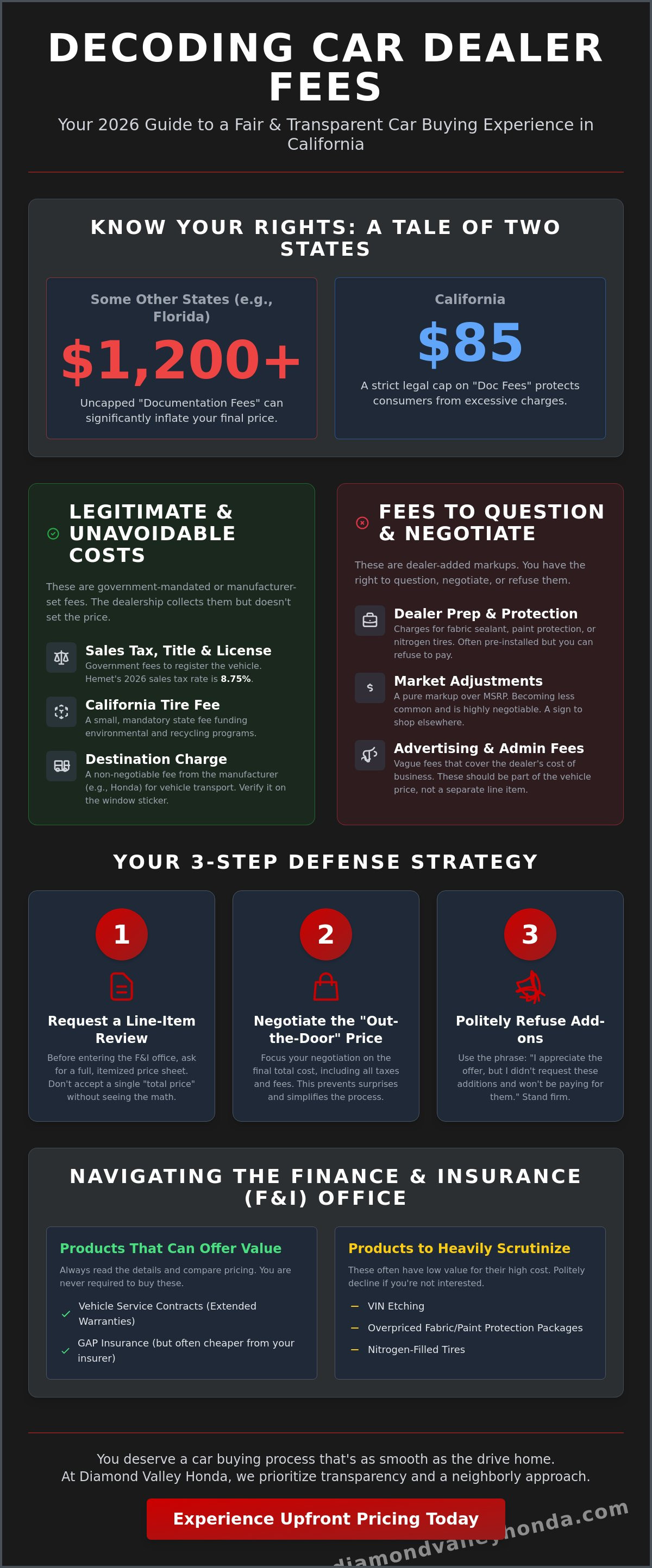
Did you know that while some car buyers in Florida are hit with documentation fees exceeding $1,200, the maximum a California dealer can charge you is strictly capped at $85? Understanding these local protections is your first line of defense when learning how to avoid hidden fees at a car dealership here in Hemet. We know that the final steps of buying a car often feel overwhelming, especially when you're faced with complex financial jargon and the stress of the finance office. You deserve a process that's as smooth as the drive home in your new vehicle.
We agree that nobody likes surprises when it's time to sign the contract. That's why we've put together this 2026 guide to help you spot unnecessary "junk fees" and negotiate with total confidence. You'll learn which charges are legitimate, such as our local 8.75% sales tax, and which ones you should politely decline. We'll also preview the new California CARS Act protections and provide a clear checklist to ensure you get a fair, transparent price on everything from a New Honda CR-V to our used vehicle inventory.
Key Takeaways
- Learn the crucial difference between mandatory government costs and negotiable dealer markups to protect your budget from the start.
- Discover exactly how to avoid hidden fees at a car dealership by requesting a full line-item review before you ever step into the finance office.
- Master the "Out-the-Door" pricing strategy to simplify your negotiation and avoid the common trap of focusing only on monthly payments.
- Identify which Finance & Insurance products offer genuine value, such as Vehicle Service Contracts, and which are simply unnecessary add-ons.
- Understand how a transparent, neighborly approach in Hemet ensures you drive home in your new vehicle without any stressful surprise charges.
Understanding Legitimate Costs vs. "Junk" Fees
Before you sign for a New Honda Accord or any model from our used vehicle inventory, you need to see a clear breakdown of every dollar. Real costs are the ones required by law or the manufacturer. Everything else is often a choice. A thorough breakdown of car ownership costs includes both these initial fees and long-term expenses like maintenance. Junk fees are unnecessary dealer-added markups for services with little consumer value.
Requesting a line-item review is the most effective way to learn how to avoid hidden fees at a car dealership. Don't settle for a single "out-the-door" number without seeing the math behind it. In 2026, California buyers often see "electronic filing" fees on their quotes. These cover the cost of processing your registration digitally. While common, you should verify these charges against the state's strict limits. California law protects you more than most other states. For instance, the documentation fee is capped at $85 for dealers who are private industry partners with the DMV. If you see a doc fee higher than this on a Southern California quote, it's a major red flag that warrants a conversation.
Unavoidable Costs: Tax, Title, and License
These fees are non-negotiable because the dealership simply collects them on behalf of the government. In Hemet, the total sales tax rate for 2026 is 8.75%. This total includes the California state tax, Riverside County tax, and our specific Hemet city and district taxes. Beyond tax, you'll pay registration and title fees that go directly to the California DMV to legally put the car in your name. You will also see the California Tire Fee. This is a small, mandatory charge used by the state to fund tire recycling and environmental programs. We keep these figures transparent because they are fixed by law, ensuring you know exactly where your money is going.
The Destination Charge: Why It Is Non-Negotiable
The destination charge is a fee that comes directly from the manufacturer, such as Honda, to cover the cost of transporting the vehicle from the factory to the lot. Because this price is set by the manufacturer, it is the same regardless of which Hemet dealer you visit. You can easily verify this cost by looking at the Monroney label, which is the original window sticker. If a dealer tries to add a second "delivery" or "prep" fee on top of the official destination charge, you are likely looking at a redundant markup. Seeing the manufacturer's price in black and white helps you stay grounded and confident during the closing process.
Common Dealer Fees You Should Question (and How to Refuse Them)
Identifying the extra charges on a sales contract can feel like a game of hide-and-seek. Learning how to avoid hidden fees at a car dealership starts with knowing which line items are actually optional products you never requested. In Southern California, it's common to see a second sticker next to the official Monroney label. This addendum often lists thousands of dollars in pre-installed accessories. While a salesperson might say these are already on the car, you aren't legally required to pay for them if you didn't ask for them.
The $85 California documentation fee is another firm line in the sand. If a dealer tries to charge a "processing fee" or "electronic filing fee" that pushes this total above $85, they're testing your knowledge of state law. Stick to your guns on this specific number. It's a clear indicator of whether a dealership values transparency or is looking for a quick markup. For a more straightforward experience, you can always browse our Used Vehicle Inventory where we prioritize clear, upfront pricing.
Dealer Prep and Protection Packages
Many buyers feel pressured to accept fabric protection, paint sealant, or nitrogen-filled tires because they're told the work is already done. You can simply say, "I didn't request these additions and I won't be paying for them." If the dealer insists, ask them to remove the product or the charge. Most will choose to remove the charge to keep the deal moving. This is especially true under the Federal Trade Commission's CARS Rule, which prohibits dealers from charging for add-ons that provide no actual benefit. Market adjustments are also becoming much less common in 2026. If you see one, it's often a sign to look for a more community-focused partner.
Advertising and Administrative Fees
Distinguishing between legitimate costs and "Advertising Fees" is vital. Dealers pay "Floor Plan" interest to keep cars on the lot, but that's an operational expense, not a line item for the buyer. Similarly, you should never pay a fee for the dealer to "prepare" a new vehicle for sale. This process is already covered by the manufacturer. If you see "Handling" or "Delivery" fees that look like the destination charge, point it out. You've already paid for the trip from the factory; you shouldn't pay for the trip from the back of the lot to the front. Watch out for redundant charges that claim to extend your coverage, as these are often already handled by your manufacturer warranty.
The "Out-the-Door" Pricing Strategy: Your Best Defense
Negotiating a car deal shouldn't feel like a guessing game. The most powerful tool in your arsenal is the "Out-the-Door" (OTD) price. This number represents the absolute total you will pay, including the vehicle price, Hemet's 8.75% sales tax, registration, and all fees. Without this number, you're only seeing part of the picture. Many shoppers fall into the trap of negotiating based on a monthly payment. Dealers can easily hit a target monthly number by stretching out the loan term or hiding high interest rates and fees. This is a common way people miss how to avoid hidden fees at a car dealership. Always keep the conversation focused on the total OTD price first.
Getting a written quote before you make the drive from Temecula or Murrieta is essential. It saves you time and prevents the frustration of seeing new charges appear once you arrive. A reputable dealer will have no problem emailing you a clear breakdown. This transparency builds trust and ensures that the price you discussed over the phone is the price you see on the contract. It puts you in control of the narrative before you ever step onto the lot.
Requesting the Buyer’s Order Worksheet
Before you commit to a deal, ask the dealer for a signed buyer's order worksheet. This document lists every single charge in a logical sequence. Here is how to handle the request:
- Ask for a line-item breakdown of the OTD price via email so you have it in writing.
- Verify that the documentation fee is the legal $85 limit for California.
- Check for "packed" payments where the monthly cost is higher than the math suggests for the given interest rate.
Comparing these worksheets from different Inland Empire dealers side-by-side lets you see exactly who is being transparent. It's much easier to spot a hidden markup when you have two documents to look at. If one dealer includes a "theft recovery" charge and another doesn't, you know exactly what to question.
The Power of Being Ready to Walk Away
Your greatest leverage is your willingness to leave. If a dealer refuses to provide a written quote or gives vague answers about specific line items, it's a clear sign they aren't being transparent. Trust your instincts. If a deal feels forced or confusing, it probably is. Timing matters too. Visiting at the end of the month or quarter can often lead to better flexibility as teams work to meet community sales goals. Being prepared with how to finance a car knowledge ensures you stay in the driver's seat during the entire process. If the numbers don't add up, don't be afraid to walk away. A reliable partner will always be happy to explain every charge clearly and honestly.
Navigating the Finance & Insurance (F&I) Office Without Overpaying
The Finance and Insurance (F&I) office is the final stage of your car-buying journey. While you might feel like the hard part is over, this is actually where many buyers lose the most money. It's the primary room where markups are introduced under the guise of "protection." Learning how to avoid hidden fees at a car dealership requires staying sharp during this final hour. You'll be presented with a stack of paperwork, often at a brisk pace. Take your breath. You have every right to read every line before you pick up the pen.
Don't let the excitement of a new vehicle cloud your judgment. The person across the desk is often a skilled salesperson whose job is to increase the dealership's profit per deal. By distinguishing between genuine protection products and unnecessary "junk," you keep your hard-earned money where it belongs. If you want a partner that respects your budget and your time, explore our transparent vehicle options today.
Extended Warranties and Maintenance Plans
Not every product offered in the F&I office is a waste of money. A Vehicle Service Contract can provide long-term peace of mind if you plan to keep your car for several years. However, you should decide based on your own driving habits rather than a high-pressure pitch. We believe in transparency, which is why our honda service center plans are designed to be straightforward and helpful. If a dealer pushes a high-markup third-party warranty, it's okay to say no. Under the California CARS Act, which takes effect October 1, 2026, dealers are prohibited from selling add-on products that offer you no benefit. Always check the fine print to ensure the coverage matches your needs.
GAP Insurance and VIN Etching
VIN etching is one of the most common "junk fees" you'll encounter. This is a process where the vehicle identification number is etched into the glass. While it's marketed as a theft deterrent, many insurance companies don't offer a significant discount for it, and the cost is often highly inflated. On the other hand, GAP insurance can be very valuable if you're financing a large portion of the car's value. It covers the "gap" between what you owe and what the car is worth if it's totaled. Just be aware that your bank or personal insurance provider might offer it at a lower rate. Watch out for "loan packing," which is when these products are added to your contract without your explicit consent. A professional, neighborly dealership will always be happy to explain every charge clearly and honestly.
Why Transparency Matters: The Diamond Valley Honda Approach
Buying a car should be an exciting milestone, not a source of anxiety. While we've spent this guide explaining how to avoid hidden fees at a car dealership, the simplest solution is to work with a team that values honesty as much as you do. Our neighborly approach isn't just a marketing slogan; it's a commitment to every driver who walks through our doors. From San Jacinto to Riverside, locals trust us for our used cars for sale because we provide a "No-Hassle" quote that matches the final contract exactly. There are no surprises, no hidden markups, and absolutely no pressure. We want you to feel at home here.
We believe that a well-informed buyer is a happy owner. That's why we take the time to break down every line item, from the local sales tax to the state-mandated registration fees. You won't find us "packing" payments or slipping in pre-installed accessories without your consent. We're here to build long-term relationships, not just secure a one-time transaction. Trust your gut. If a dealer isn't being clear, they aren't the right partner for you.
Our Transparent Pricing Policy
We apply our transparency standards to every vehicle on our lot. Whether you are browsing our online inventory for a new honda crv or a reliable used sedan, the pricing you see is clear and direct. When you understand how to avoid hidden fees at a car dealership, you'll quickly see why our straightforward pricing stands out in the Southern California market. The moment you ask for a quote, we provide a full breakdown of costs. This includes all legitimate fees and taxes, allowing you to see the true "out-the-door" price before you ever visit the showroom. Our commitment to the Hemet community means we treat our neighbors with the respect and integrity they deserve. We know that word-of-mouth travels fast in our town, and we've built our reputation on being a reliable partner in the Inland Empire.
Start Your Stress-Free Journey Today
Ready to experience a different kind of car buying? We invite you to browse our inventory online or stop by our Hemet showroom to meet our team. Our factory-trained professionals prioritize education over "the hard sell." We'll walk you through your options, explain the benefits of various Vehicle Service Contracts, and help you find the perfect fit for your lifestyle. You'll never feel rushed during the final signature process here. We want you to drive away feeling confident and secure in your choice. Visit Diamond Valley Honda today for a car-buying experience built on trust, transparency, and local pride.
Drive Home with Confidence and Clarity
Mastering the "out-the-door" price and understanding state-mandated caps, like the $85 documentation fee, are your best defenses against unwanted markups. Armed with this knowledge, you can navigate the finance office without the stress of unexpected charges appearing on the final contract. This 2026 guide serves as your personal roadmap for how to avoid hidden fees at a car dealership, ensuring you get the fair deal you deserve as a local buyer.
As a top-rated Hemet Honda dealer, we are dedicated to a transparent F&I process that puts your needs first. We offer no-haggle pricing options on our entire selection to keep your experience simple, honest, and completely predictable from start to finish. Browse Our Transparently Priced Inventory at Diamond Valley Honda and see the difference a neighborly partner makes. You've done the research and prepared yourself for a successful purchase. Now it's time to enjoy the road ahead in a vehicle you love with the peace of mind that comes from a truly transparent deal.
Frequently Asked Questions
What are the most common hidden fees at a car dealership?
Common hidden fees include nitrogen-filled tires, door edge guards, and "dealer prep" charges. These items are often pre-printed on the sales contract to make them look mandatory, but they are actually optional dealer markups. Knowing which charges are choice-based is a vital part of how to avoid hidden fees at a car dealership. Always ask for an itemized list of every fee before you discuss any monthly payments.
Is the documentation fee negotiable in California?
The documentation fee is not typically negotiable, but it is strictly limited by state law. As of June 2026, the maximum allowable documentation fee is $85 for dealers who are private industry partners with the DMV. If you see a doc fee higher than $85 on a California contract, the dealer is likely adding an illegal markup. You should insist that they correct the amount to reflect the legal limit.
Can I refuse to pay for dealer-installed accessories like window tint or alarms?
You have the right to refuse payment for any accessory you didn't specifically request. Even if window tint or an alarm system is already on the vehicle, you can ask the dealer to remove the charge from your bill. The California CARS Act, taking effect October 1, 2026, prohibits dealers from charging for add-on products that provide no actual benefit to the consumer. Stick to your budget and decline any "pre-installed" items you don't want.
What is an "Out-the-Door" price and why should I ask for it?
An "Out-the-Door" (OTD) price is the total sum of the vehicle cost plus all taxes, registration fees, and documentation charges. You should ask for this number early because it prevents dealers from hiding extra fees inside a monthly payment. It's the only figure that allows you to accurately compare offers between different Inland Empire dealerships without any surprises later in the process.
How do I know if a dealer is "packing" my car loan?
You can identify "loan packing" by running the numbers on a loan calculator to see if the monthly payment matches the quoted interest rate and loan term. If the dealer's payment is higher than the math suggests, they may have slipped in products like GAP insurance or service contracts without your explicit consent. Always review the final finance agreement line-by-line to ensure no unauthorized products were added to the total.
Should I pay for VIN etching or fabric protection?
Most buyers should decline VIN etching and fabric protection, as these are high-margin items that offer very little real-world value. VIN etching is often redundant because many modern insurance policies already provide theft protection or recovery assistance. Fabric protection is usually a simple spray treatment that you can apply yourself for a fraction of the dealer's price. Declining these "junk fees" is an easy way to save hundreds of dollars.
What fees are legally required when buying a car in Hemet, CA?
The legally required fees in Hemet include the 8.75% sales tax, DMV registration and title fees, and the California Tire Fee. You'll also pay the $85 documentation fee if the dealer is a DMV private industry partner. These costs are non-negotiable because the dealership collects them on behalf of the state and local government. Any other fee on your quote is likely a dealer-imposed charge that you should question.
How can I tell if an extended warranty is a good deal or a junk fee?
A legitimate Vehicle Service Contract is a good deal if it provides comprehensive coverage that matches your driving habits and the length of time you plan to keep the car. It becomes a junk fee when it's a high-markup third-party plan with many exclusions and hidden "deductibles." Understanding how to avoid hidden fees at a car dealership means researching your warranty options ahead of time so you can choose a plan that offers genuine protection.