That "great deal" on generic brake pads at a local Perris parts store might actually be the most expensive mistake you make for your vehicle's longevity. We understand how frustrating it is to hear that high-pitched squeal every time you slow down for a red light or feel that uneasy vibration when you're merging onto the I-215. You deserve a smooth, quiet ride without worrying if your car will stop exactly when it needs to during a sudden traffic jam. Choosing genuine Honda brake pads Perris drivers rely on is about more than just stopping; it's about maintaining the precise engineering that keeps your Honda running like new.
In this guide, you'll discover why factory-grade parts are the only choice for those seeking safety, durability, and a perfect fit. We will explain how these pads protect your rotors from expensive damage and why your Honda's advanced safety systems depend on them to function correctly. By the end, you'll see how professional installation and the right materials provide the peace of mind you need for every commute across Riverside County. You'll learn exactly why the "savings" of aftermarket pads often disappear when faced with the heat and traffic of the Inland Empire.
Key Takeaways
- Learn why genuine Honda brake pads Perris drivers choose are engineered specifically for your vehicle's weight and braking system to ensure a perfect factory fit.
- Understand how high-grade ceramic and metallic blends protect your braking performance against the extreme heat and traffic congestion of the Inland Empire.
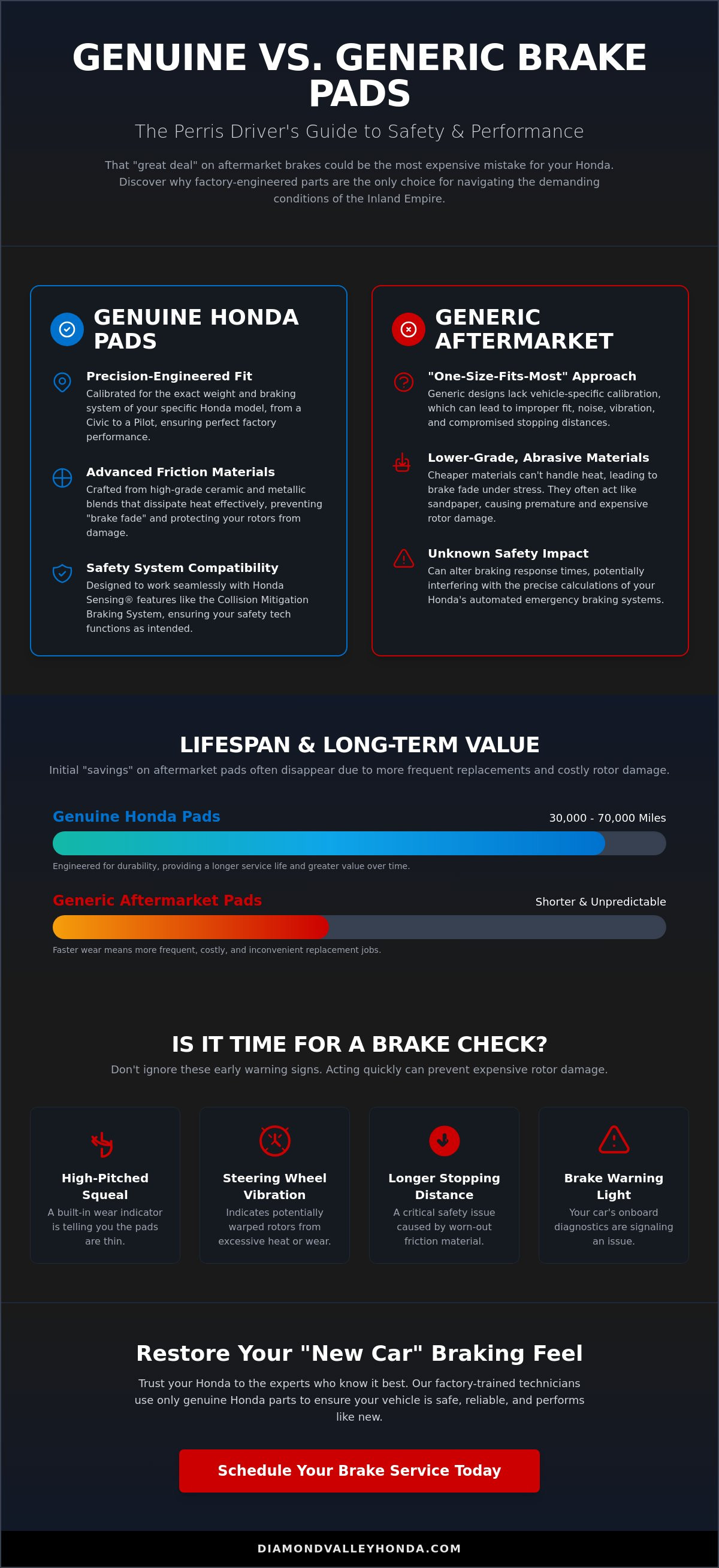
- Compare the long-term value of OEM parts, which typically last between 30,000 and 70,000 miles, against the hidden costs of cheap aftermarket alternatives.
- Identify the early warning signs of brake wear, such as high-pitched squeals or steering wheel vibrations, before they lead to costly rotor damage.
- Discover how factory-trained technicians can restore your "new car" braking feel while providing the peace of mind that comes with specialized Honda expertise.
Why Genuine Honda Brake Pads are Critical for Perris Drivers
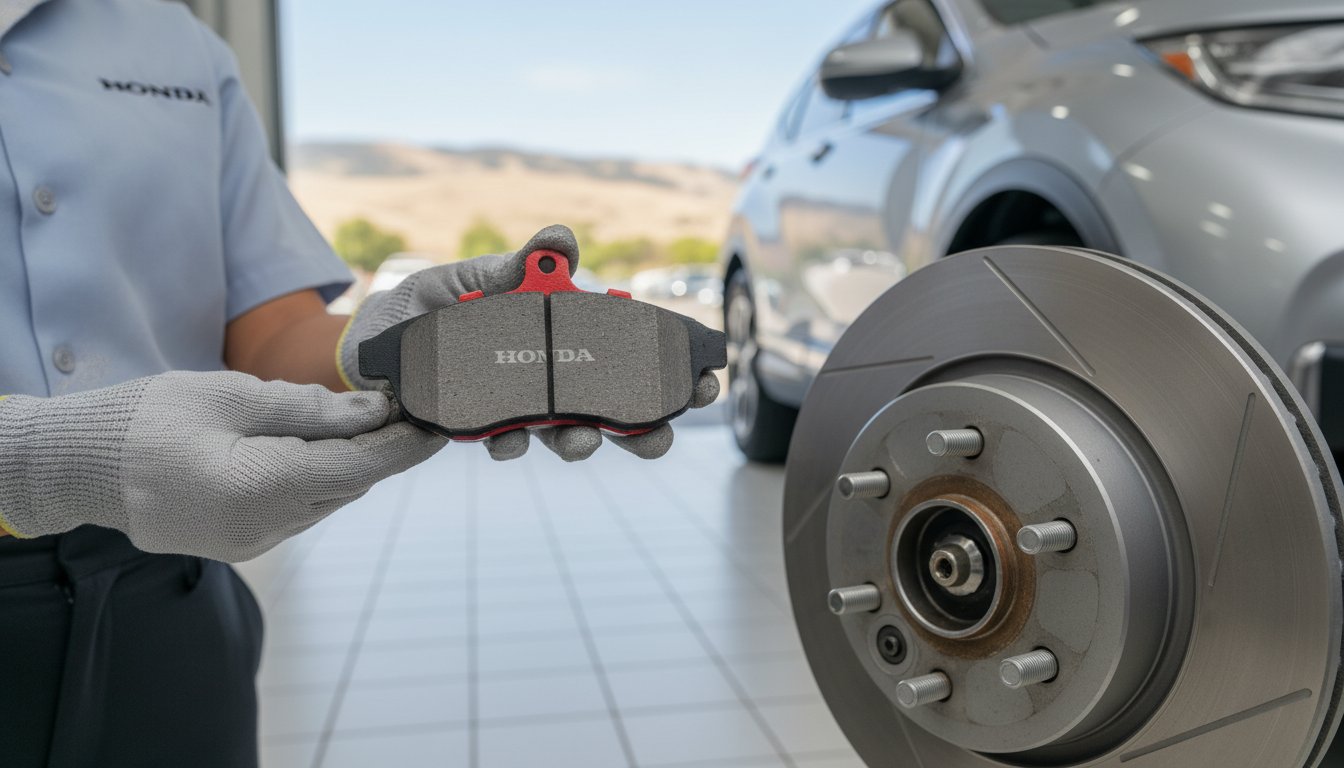
To understand your car's stopping power, you first have to ask: What are brake pads? At their core, these are the friction components that press against your rotors to slow your wheels. Unlike generic parts found at big-box retailers, genuine Honda brake pads Perris owners receive at a dealership are engineered specifically for the exact weight and braking system of your vehicle. Honda doesn't use a "one size fits all" approach. Instead, they calibrate the friction material to match the kinetic energy of your specific model, whether you're driving a compact Civic or a three-row Pilot.
This precision is vital because it prevents "brake fade," a dangerous condition where your brakes lose effectiveness after repeated use. Generic pads often use lower-grade materials that can't dissipate heat quickly. When your pads overheat, they can't create the friction needed to stop, which is a risk you can't afford when navigating the busy intersections of Riverside County. Genuine OEM pads are rigorously tested to ensure they maintain their grip even under extreme stress, keeping your stopping distances consistent every time you hit the pedal.
The Inland Empire Driving Challenge
We've all been there: sitting in stop-and-go traffic on the I-215 or Highway 74 while the outside temperature climbs past 100 degrees. Perris heat is brutal on vehicle components, especially your braking system. High ambient temperatures accelerate the degradation of friction materials, leading to faster wear and reduced performance. When you combine this heat with the constant braking required in local school zones and residential neighborhoods, your pads work twice as hard. Using parts designed for these conditions ensures your vehicle remains reliable, even during the peak of a Southern California summer.
Safety First: The Role of OEM Engineering
Modern Honda vehicles are equipped with Honda Sensing, an advanced suite of safety technologies that includes the Collision Mitigation Braking System. These systems are calibrated based on the performance of factory parts. If you install "universal fit" pads, you might unknowingly change how your car responds during an automated emergency stop. Genuine pads ensure that these safety features work exactly as the manufacturer intended. Furthermore, using factory-authorized parts helps maintain the integrity of your vehicle's warranty. It's also a smart move to keep up with other maintenance; for instance, Honda recommends a brake fluid exchange every three years to keep the entire system responsive. Investing in genuine Honda brake pads Perris drivers can trust means you're not just buying a part; you're maintaining the safety standards that made you choose a Honda in the first place.
The Anatomy of Stopping Power: What Sets Honda Pads Apart
When you hold a brake pad in your hand, it looks like a simple block of friction material attached to a metal plate. However, the engineering required to stop a 3,000-pound vehicle traveling at highway speeds is incredibly complex. Unlike the generic semi-metallic pads found in big-box stores, genuine Honda brake pads Perris owners receive are crafted from a proprietary blend of high-grade ceramic and metallic fibers. This specific composition is designed to handle the kinetic energy of your exact Honda model without compromising the metal of your rotors. It is helpful to understand that while all replacement parts fall under Federal Motor Vehicle Safety Standards as vehicle equipment, Honda’s internal benchmarks for performance and material density are significantly more rigorous than the baseline requirements.
Honda uses a specialized manufacturing process that ensures consistent density across the entire friction surface. This matters because "hot spots" in lower-quality pads can lead to uneven stopping power and warped rotors. By maintaining a uniform structure, these pads wear down at a predictable rate, which helps you avoid the surprise of a metal-on-metal grinding sound. These components are also designed to be exceptionally "rotor-friendly." Instead of acting like sandpaper on your discs, they work in harmony with the metal to extend the life of the entire braking system, ultimately saving you from expensive resurfacing or replacement costs down the road.
Advanced Friction Materials
The ceramic formulations used by Honda are engineered to manage heat dissipation far better than standard aftermarket options. During heavy braking sessions, such as coming down a steep grade or navigating a sudden stop on the freeway, heat builds up rapidly. Honda's materials are tested to resist this thermal stress, preventing the material from glazing over and becoming slick. A critical part of this process is the development of a transfer layer. The transfer layer is a microscopic film of friction material that bonds to the rotor surface, allowing for smooth, consistent stopping power without grinding away the underlying metal. This microscopic bond is what gives your Honda that responsive, "new car" pedal feel.
Precision Fit and Noise Reduction
Noise is often the first complaint drivers have after installing cheap pads. Honda addresses this by using multi-layer shims that act as tiny shock absorbers to dampen high-frequency vibrations. These vibrations are the root cause of that piercing squeal you hear at stoplights. Additionally, every genuine pad features precise chamfer and slot designs. These angled edges and grooves aren't just for show; they direct gases and dust away from the contact patch and help the pad seat perfectly against the rotor. This precision fit prevents "pad slap" and ensures the pad moves freely within the caliper, which is why choosing Honda Genuine Parts is the simplest way to ensure a quiet and comfortable commute.
Genuine Honda Parts vs. Aftermarket: A Performance Comparison
Choosing between factory parts and aftermarket alternatives often feels like a simple budget decision. It's actually a choice about the long-term health and safety of your vehicle. While generic parts are cheaper at the checkout counter, they often lack the endurance of genuine Honda brake pads Perris drivers rely on for their daily commutes. Genuine pads typically last between 30,000 and 70,000 miles, whereas many budget alternatives need replacement in half that time. When you calculate the cost-per-mile, the factory option almost always wins. You'll spend less time in the service bay and more time on the road.
Another major advantage is the reduction in unsightly brake dust. High-quality OEM pads keep your wheels cleaner for much longer periods. This isn't just about keeping your car looking sharp; it's about advanced material science. Honda actively participates in the Copper-Free Brake Initiative, ensuring that modern friction materials are environmentally responsible without sacrificing stopping power. This shift to safer materials results in a linear, predictable pedal feel. You won't have to guess how much pressure to apply; the car responds exactly as you expect every single time.
Durability and Rotor Longevity
Many aftermarket manufacturers use incredibly hard friction materials to artificially boost the lifespan of the pad. This comes at a heavy cost to your vehicle. These hard pads act like sandpaper, scoring or warping your rotors over time. What started as a cheap pad swap can quickly turn into a much more expensive repair bill involving full rotor replacement. Following expert automotive maintenance tips is the best way to protect your investment and avoid these cascading mechanical issues.
- Budget Aftermarket Pads: 15,000 to 25,000 miles (High rotor wear)
- Standard Aftermarket Pads: 25,000 to 40,000 miles (Inconsistent performance)
- Genuine Honda OEM Pads: 30,000 to 70,000 miles (Optimized for rotor health)
Noise, Vibration, and Harshness (NVH)
That annoying squeak you hear at every red light in Perris is usually the result of poor-quality materials or a bad fit. Aftermarket pads often struggle with the "bedding-in" process, where the pad and rotor must transfer material to one another to function correctly. Because genuine Honda brake pads Perris owners choose are designed for a smooth transition, they offer a quiet, vibration-free experience from the moment you leave the shop. You deserve the peace of mind that comes with a smooth stop, whether you're navigating neighborhood streets or slowing down for heavy traffic on the 215. This reliability is why sticking with factory standards is the smartest choice for your Honda.
When to Replace Your Brake Pads: Signs for Perris Owners
Recognizing the early warning signs of brake wear is the best way to avoid a dangerous situation on the road. Most genuine Honda brake pads Perris drivers use are equipped with built-in wear indicators, also known as wear tabs. When your pad material gets low, these small metal tabs make contact with the rotor to produce a high-pitched squeal. It is a deliberate design feature meant to grab your attention before the damage becomes severe. If you hear this sound, it is time to have a professional look at your system.
Beyond sound, your car communicates through physical sensations. If you feel a pulsating sensation in the brake pedal or a vibration in the steering wheel while slowing down, it often signals that your pads are unevenly worn or your rotors have developed run-out. You might also notice your vehicle pulling to one side when you apply pressure to the brakes. This often indicates that one caliper is working harder than the other or that the pads on one side have degraded faster than the rest. Each of these symptoms suggests that your stopping power is no longer balanced or reliable.
A quick visual check can also give you a head start. Most modern Honda wheels have open spokes that allow you to see the brake caliper without removing the tire. Look for the friction material pressed against the shiny metal rotor. If the pad looks to be less than 3 millimeters thick, about the thickness of two stacked pennies, you are nearing the end of its service life. Catching this early prevents the pad from wearing down to the metal backing plate.
Common Warning Signals
If the squealing turns into a harsh grinding noise, you have likely reached metal-on-metal status. This means the friction material is completely gone, and the metal backing plate is digging into your rotor. This is an emergency that requires immediate attention to prevent total brake failure and costly rotor damage. You should also watch for a spongy pedal feel. This can happen if the pads are severely compressed or if the brake fluid has overheated. Always pay attention to the brake dashboard light; it is your car's way of monitoring fluid levels and electronic system health.
The Multi-Point Inspection Advantage
While DIY checks are helpful, a professional inspection at a Honda service center provides a level of precision that a driveway glance cannot match. Factory-trained technicians use specialized tools to measure pad thickness in exact millimeters, ensuring you aren't replacing parts too early or waiting until it's too late. They also inspect brake lines for cracks and verify that your fluid is clean and at the correct level. This comprehensive approach ensures that when you install genuine Honda brake pads Perris, the rest of the system is ready to support them. If you have noticed any of these warning signs, visiting a trusted expert for a thorough brake health check is the smartest move for your safety.
Expert Honda Brake Service Near Perris at Diamond Valley Honda
Finding a reliable partner for your vehicle's maintenance shouldn't be a stressful experience. For drivers in Perris, Diamond Valley Honda serves as the premier destination for professional care, located just a short and convenient drive away in Hemet. We've built our reputation on being a trusted local resource that understands the specific needs of our community. When you bring your vehicle to us, you aren't just getting a standard repair. You're getting the expertise of factory-trained technicians who spend every day working exclusively on Honda models like the Civic, Accord, and CR-V. This specialization ensures that every installation of genuine Honda brake pads Perris owners require is performed with surgical precision.
We take pride in the "Diamond Valley Difference." This philosophy centers on a transparent, customer-first approach that avoids the high-pressure tactics often found at larger corporate chains. We believe in providing clear information so you feel empowered to make the best decisions for your car. Our commitment to quality is backed by the peace of mind you deserve. Most genuine Honda brake pads Perris drivers receive at our center, along with the expert labor provided, are typically accompanied by a 12-month or 12,000-mile warranty. It's a grounded, reliable way to ensure your Honda remains as safe as the day you first drove it home.
Why Choose Our Service Center?
Generic repair shops in the area often rely on universal equipment that might not read your Honda's computer system accurately. We use specialized Honda diagnostic tools designed to interface perfectly with your vehicle's advanced safety systems. This technical edge allows us to identify wear patterns or hydraulic issues that others might miss. Our location is strategically placed to serve residents in Menifee, San Jacinto, and Perris, making it easy to drop off your car and get back to your day. Before you visit, we encourage you to check our website for current service specials on brake pad replacement. We frequently update these offers to provide the best value for our neighbors.
Scheduling Your Appointment
We know that Perris families have busy schedules. That's why we've streamlined our online scheduling process to be as quick and easy as possible. You can book your time from your phone or computer in just a few clicks. While our technicians service your brakes, you can relax in our comfortable waiting area equipped with modern amenities designed to make your stay pleasant. We aim to provide a brisk, purposeful rhythm to our service so you can get back to your life without unnecessary delays. Trust your stopping power to the people who know your car best. Schedule your Honda brake service today and let us help you maintain your vehicle's performance for years to come.
Drive with Confidence Across the Inland Empire
Your safety on the road depends on the components that sit between your car and the asphalt. Choosing the right materials protects your rotors and ensures your advanced safety systems function exactly as intended. By opting for genuine Honda brake pads Perris drivers can trust, you're investing in the long-term reliability and responsive feel of your vehicle. It's the simplest way to maintain the high standards of engineering that Honda is known for, ensuring every stop is as smooth as the first.
At Diamond Valley Honda, we've been serving Perris and the Inland Empire since inception. Our factory-trained technicians use only Genuine Honda OEM Parts to guarantee a perfect fit every time. Don't wait for a grinding sound to tell you it's time for maintenance. Proactive care is the smartest way to avoid expensive repairs and keep your family safe during every commute through Southern California.
Schedule Your Professional Honda Brake Service Near Perris today. We look forward to being your trusted partner in maintaining a smooth, quiet, and reliable ride for years to come.
Frequently Asked Questions
How much does it cost to replace Honda brake pads in Perris?
The total cost for a brake pad replacement varies depending on your specific model and whether your rotors require resurfacing or replacement. Since every vehicle has unique needs based on its mileage and condition, we recommend contacting our service department for a personalized estimate. Our team provides transparent breakdowns so you know exactly what is required to keep your Honda safe and reliable.
How long do genuine Honda brake pads typically last?
Most genuine Honda brake pads last between 30,000 and 70,000 miles, though your specific results depend on your driving style. Frequent commuting in stop-and-go traffic on the I-215 or heavy braking in the summer heat can accelerate wear. Regular multi-point inspections are the most effective way to monitor your pad thickness and plan for a replacement before performance drops.
Can I just buy the pads and install them myself?
Yes, you can purchase genuine Honda parts directly from our parts counter if you prefer to handle the maintenance yourself. While many owners have the tools for a DIY swap, professional installation ensures that the calipers are properly lubricated and the hardware is torqued to factory specifications. Our technicians also check for hydraulic leaks and rotor run-out that might be missed during a home installation.
Is there a difference between front and rear brake pads?
Front and rear brake pads are not interchangeable because they are engineered for different workloads. The front brakes typically handle about 70 percent of the stopping force, meaning those pads are usually larger and designed to dissipate more heat. Using the correct part number for each axle is critical for maintaining the balanced braking performance your Honda was designed to deliver.
What happens if I wait too long to change my brake pads?
Waiting too long allows the friction material to wear down to the metal backing plate, which causes immediate and expensive damage to your rotors. This "metal-on-metal" contact generates extreme heat that can also damage your brake calipers and seals. More importantly, severely worn pads increase your stopping distance, which puts you and your passengers at greater risk during a sudden stop.
Do new brake pads come with a warranty at Diamond Valley Honda?
When you choose genuine Honda brake pads Perris owners receive at our dealership, the parts and labor are typically backed by a 12-month or 12,000-mile warranty. This coverage ensures that if any defect in materials or workmanship arises, you are protected at any authorized Honda dealer. It is a level of security that you rarely find with budget aftermarket parts or independent repair shops.
Why are my brakes squeaking even though the pads are new?
New brakes might squeal if the rotors were not properly cleaned or if the pads haven't finished the "bedding-in" process, which transfers a thin layer of friction material to the rotor. In some instances, a lack of proper lubrication on the backing plate or shims can also cause high-frequency vibrations. If the noise doesn't disappear after a few days of normal driving, a quick inspection can identify if a simple adjustment is needed.
Does Diamond Valley Honda offer brake inspections for Perris drivers?
We provide comprehensive brake inspections as part of our standard multi-point service to help you stay ahead of potential issues. Our technicians measure your pad thickness in millimeters and check the condition of your brake lines and fluid levels. This proactive approach helps Perris drivers avoid the stress of unexpected repairs while ensuring their vehicle remains in peak stopping condition.