
Would you spend $1,000 today to prevent a $5,000 repair bill next month? For many Hemet drivers, the cost to replace Honda timing belt isn't just another maintenance expense; it's a vital insurance policy for your engine. Since most Honda models use interference engines, a single snapped belt causes pistons and valves to collide. According to 2025 reports from ATLR, this results in the kind of catastrophic damage that often requires a total engine replacement.
We understand that seeing a service quote between $409 and $1,512 can feel overwhelming when you're just trying to keep your Inland Empire commute reliable. It's frustrating to deal with technical jargon when you simply want peace of mind. This guide explains the real factors behind these prices, using data updated by RepairPal in January 2026 and Kelley Blue Book in May 2026. You'll learn how to verify if your vehicle's reached its 105,000-mile or 7-year replacement window. You'll also see why professional Honda service justifies the investment by protecting your vehicle’s longevity and your family's safety. We'll break down the labor-to-parts ratio so you feel confident and informed before you visit us in Hemet.
Key Takeaways
- Understand why expert labor accounts for the majority of your service bill and how to budget for your specific Honda model.
- Learn how the cost to replace Honda timing belt acts as a safeguard against the catastrophic "valve vs. piston" collisions common in interference engines.
- Discover the "While-You-Are-In-There" strategy that lets you replace your water pump for essentially zero additional labor cost.
- Identify the subtle signs of belt wear that most drivers miss, helping you schedule service before a breakdown on the I-15.
- See how choosing factory-trained technicians ensures your engine’s precision timing and includes a 12-month warranty for total peace of mind.
Understanding the Cost Factors of Honda Timing Belt Replacement
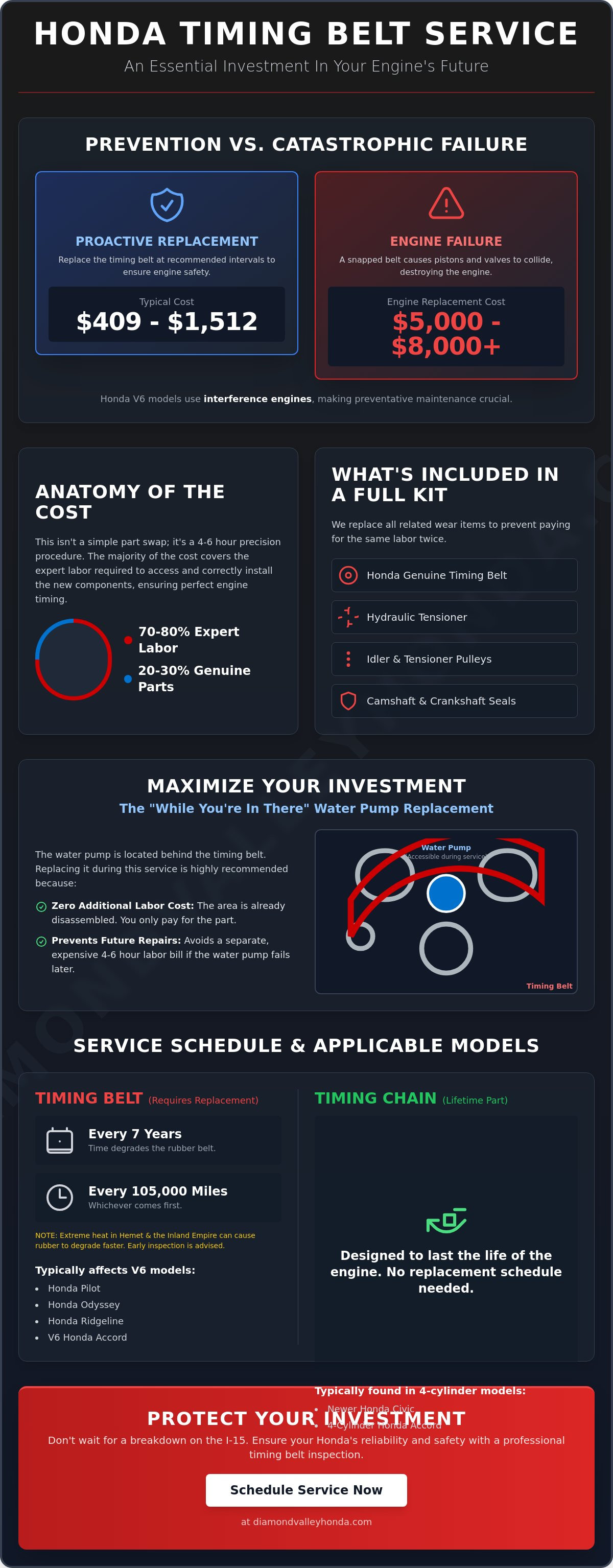
Think of your engine as a high speed orchestra. The timing belt is the conductor. It ensures the valves open and close at the exact millisecond required to sync with the pistons. If you want a deep dive into what a timing belt does, it essentially bridges the gap between the crankshaft and camshaft. When you see a quote for the cost to replace Honda timing belt, you might notice the parts themselves aren't the most expensive item. In fact, 70% to 80% of your bill usually covers expert labor. This isn't a simple maintenance task like an oil change; it's a surgical procedure for your engine.
Living in Hemet or Temecula means we deal with specific Southern California labor rates. While national averages provide a baseline, our local cost of living and the high demand for factory-trained technicians in the Inland Empire influence the final price. We prioritize transparency because we know you want to understand exactly where your hard-earned money is going. We're not just swapping a belt; we're resetting the heartbeat of your vehicle.
Not every Honda requires this service. If you drive a newer Honda Civic or a 4-cylinder Honda Accord, your vehicle likely uses a timing chain. These are designed to last the lifetime of the car. However, if you own a Honda Pilot, Honda Odyssey, Honda Ridgeline, or a V6 Honda Accord, your engine relies on a rubber belt. These V6 engines are more complex and require more time to service than their 4-cylinder counterparts, which is why the service price varies between models.
Why Labor Hours Drive the Price
Accessing the timing belt is a labor-intensive process. A technician must remove the engine mount, drive belts, and several protective covers before they even see the belt. It's a 4 to 6 hour job for most V6 models. Precision is everything in this repair. Being off by even one tooth on the sprocket can cause rough idling, engine misfires, or internal damage. Our technicians use specialized tools to lock the engine in place, ensuring the timing remains perfect when the new belt is installed.
Parts Included in a Professional Service
We always recommend using Honda Genuine Parts because they're engineered specifically for your engine's heat and tension requirements. A professional service includes more than just the rubber belt. We also replace the hydraulic tensioner, which prevents the belt from slipping or developing slack. We also inspect and typically replace idler pulleys and seals. These components often wear out at the same rate as the belt, and replacing them now prevents you from paying for the same labor twice later on.
Why Timing Matters: The Risks of an Interference Engine
An interference engine is a design where valves and pistons share the same space at different times. This layout allows your Honda to achieve the high compression and fuel efficiency you rely on for your daily drives. However, it also creates a high stakes environment for your engine's internal components. If the timing belt fails while you're cruising at 65 MPH on the I-15, the synchronization between these parts stops instantly. The heavy metal pistons will continue their upward travel while the valves remain stuck in their path. The resulting collision is both violent and destructive.
When this happens, valves bend, pistons shatter, and the cylinder head often sustains irreparable cracks. You can read a detailed technical breakdown of what happens if a timing belt breaks to see why this synchronization is so critical. The financial gap between prevention and repair is massive. While the cost to replace Honda timing belt as preventative maintenance typically ranges from $1,200 to $1,800, a full engine replacement following a failure can easily climb to between $5,000 and $8,000. Investing in the cost to replace Honda timing belt before it snaps is the most effective way to protect your vehicle's value.
The 100,000-Mile Rule and Beyond
Honda generally recommends replacing the belt every 105,000 miles or every 7 years, whichever comes first. In the Inland Empire, our environment plays a significant role in how well that rubber holds up. The extreme summer heat in Hemet and the consistently dry air can cause rubber components to become brittle and crack earlier than they might in milder climates. Following these automotive maintenance tips helps you stay ahead of environmental wear. If your vehicle is approaching that seven year mark, even with low mileage, you should consider a professional inspection.
Decoding Maintenance Minder Code 4
Your Honda is smart enough to tell you when it needs attention. When you see a "4" appear in your Maintenance Minder sub-codes, your car is specifically requesting a timing belt replacement and spark plug inspection. This system doesn't just count miles; it tracks engine revolutions and operating temperatures to determine the actual wear on your components. Don't ignore or clear this code just to make the light go away. Doing so resets the internal clock without addressing the physical wear on the belt. If you've seen this code recently, our team can provide a transparent service consultation to help you plan your next steps.
The While-You-Are-In-There Strategy: Maximizing Your Investment
You've already seen how a snapped belt can lead to a $5,000 engine repair. Now, let's focus on how to get the most value for your money. When you're calculating the cost to replace Honda timing belt, you'll likely notice a water pump included in the estimate. This isn't a high-pressure upsell. It's a strategic move designed to save you hundreds of dollars in future labor. Because the timing belt physically drives the water pump, our technicians must remove the belt to reach the pump. By replacing them at the same time, you're essentially getting the labor for the water pump for free.
Imagine skipping the water pump today to save a small amount on parts. If that pump starts leaking 10,000 miles from now, you'll have to pay for the exact same 4 to 6 hours of labor all over again. Since both components have a verified lifespan of approximately 100,000 miles, it's logical to sync their replacement cycles. A standalone water pump replacement is a significant expense that most drivers want to avoid. Bundling these services ensures you aren't paying for the same disassembly twice.
The Essential Water Pump & Tensioner Bundle
Honda engineers design these internal systems to work in harmony. Understanding how a timing belt works shows that the hydraulic tensioner is just as vital as the belt itself. This component maintains the precise amount of pressure required to prevent the belt from "jumping" a tooth. A jumped belt causes the same catastrophic engine damage as a snapped one. This is why expert Honda service centers always recommend a comprehensive component kit. We want to ensure every part under that timing cover is fresh and dependable.
Drive Belts and Coolant Flush
While the front of your engine is open, it's the perfect time for a multi-point inspection of your serpentine belts. These external drive belts power your alternator and air conditioning. If our technicians spot cracks or fraying, replacing them now adds zero extra labor time to your bill. Additionally, because the water pump is a core part of the cooling system, a fresh coolant flush is required during this service. This removes old contaminants and protects your engine during those triple-digit Hemet summers. When you leave our service center, you've essentially reset your engine’s "life clock" for another 100,000 miles of peace of mind. Planning for the cost to replace Honda timing belt as a complete package is the smartest way to protect your investment.
Recognizing Signs and Scheduling for Hemet Drivers
Most automotive parts give you a warning before they quit. Brake pads squeal, and batteries struggle to crank on cold mornings. The timing belt is different. It's often called the "silent killer" because it rarely makes a sound before it snaps. If you're researching the cost to replace Honda timing belt, you shouldn't wait for a mechanical symptom to appear. By the time you hear a noise, the damage is likely already done. For those of us commuting from Hemet to Riverside or Temecula every day, a sudden failure on the I-215 or Highway 79 is more than just an inconvenience; it's a safety risk.
While the belt itself is hidden behind a protective cover, there are secondary signs that your engine is struggling. You might notice a sluggish start or an engine misfire that triggers your check engine light. Oil leaks near the front of the engine are another major red flag. If oil seeps onto the timing belt, it causes the rubber to soften and degrade rapidly. This chemical breakdown can lead to a failure long before you hit your 105,000-mile service interval. Keeping your engine clean and dry is a simple way to extend the life of your internal components.
Visual and Audible Red Flags
It's easy to confuse a squeaky serpentine belt with a timing issue. Serpentine belts are visible and often chirp when it rains or when you turn the steering wheel. A timing belt, however, is tucked away. If you or a technician remove the timing cover, you might see glazing, cracks, or fraying along the edges of the belt. These are clear indicators that the rubber has lost its structural integrity. A visual inspection by a pro is the only way to verify belt health. Our team uses specialized mirrors and lights to check for these subtle signs during every multi-point inspection.
How to Budget and Prepare
We believe in transparent service, which means helping you plan for maintenance before it becomes an emergency. When you schedule this service, expect to leave your vehicle with us for a full business day. This allows our technicians the time needed for precision disassembly and reassembly. We recommend checking our website for service specials or coupons that can help manage the cost to replace Honda timing belt. If you find that an unexpected repair bill makes you rethink your current vehicle, you might want to learn how to finance a car to see if a newer model fits your budget better. Whether you're maintaining your current Honda or looking for an upgrade, we're here to help you move forward. Schedule your professional timing belt inspection today to keep your Inland Empire commute stress-free.
The Diamond Valley Honda Service Difference
Deciding where to spend your money on the cost to replace Honda timing belt is a choice that impacts your car's long-term reliability. A general mechanic might have experience with many brands, but our factory-trained technicians specialize in the intricate details of Honda V6 engines. This specialization is critical because the clearance in an interference engine is measured in fractions of a millimeter. One small error in timing can lead to the very engine failure you're trying to avoid. We serve drivers from Hemet to Murrieta with a commitment to precision that general shops simply can't match. Our team understands that your vehicle is your lifeline for work and family, so we treat every repair with the care it deserves.
The Diamond Valley Difference is built on transparency and neighborly service. We avoid the high-pressure tactics found at larger corporate chains, opting instead for a welcoming style that builds long-term trust. We break down the cost to replace Honda timing belt into manageable, logical sequences so you feel informed rather than overwhelmed. Our modern service center mirrors the efficiency of the Honda brand, ensuring your vehicle is back on the road as quickly as possible without sacrificing quality or safety.
Genuine Honda Parts vs. Aftermarket
Honda Genuine Parts are the only components designed to meet the exact specifications of your vehicle. The specific rubber compound used in an OEM belt is formulated to resist the 100-degree heat and dry air common in the Inland Empire. Aftermarket or "will-fit" parts are often made to a generic standard, which is a dangerous gamble for high-tolerance engines. Choosing the right parts gives you the protection of a 12-month or 12,000-mile warranty. This ensures that your investment is protected and your Honda remains a dependable partner for your daily commute on the I-215.
Schedule Your Inspection in Hemet
Our team makes it easy to stay on top of your maintenance schedule. We offer a hassle-free experience that removes the stress from major repairs. When you bring your vehicle to us, we perform a complimentary multi-point inspection to identify any other potential issues before they become expensive problems. This proactive approach is a core part of being your hometown Honda dealer. We're proud to support our local community with expert care and honest advice. Schedule your Honda timing belt service at Diamond Valley Honda today.
Secure Your Engine's Future Today
Your Honda's timing belt is the single most critical maintenance item for your engine's longevity. By addressing this service before a failure occurs, you avoid the thousands of dollars in repairs that follow a snapped belt in an interference engine. Bundling your timing belt with a new water pump and tensioner isn't just smart; it's the most cost-effective way to reset your vehicle's reliability for the next 100,000 miles. We've spent decades serving the Hemet and Murrieta communities with a commitment to honesty and precision.
When you consider the cost to replace Honda timing belt, remember that you're investing in peace of mind. Our factory-trained technicians use only Genuine Honda Parts, which come backed by a 12-month, 12,000-mile warranty for your protection. Don't let a silent maintenance code turn into a roadside emergency on the I-215. We're here to provide the transparent service and expert care your vehicle deserves. Book Your Professional Honda Timing Belt Service in Hemet and keep your journey moving forward with confidence.
Frequently Asked Questions
How much does it cost to replace a Honda timing belt in California?
The typical cost to replace Honda timing belt in California currently ranges between $409 and $1,512 based on data from RepairPal and Kelley Blue Book updated in May 2026. Smaller 4-cylinder models like older Civics sit at the lower end of this scale, while larger V6 engines found in the Honda Pilot or Honda Odyssey require more labor and parts, pushing costs toward the higher end. These estimates include both Genuine Honda parts and local labor rates for the Inland Empire region.
What happens if I don’t replace my Honda timing belt?
If you don't replace the belt before it snaps, your engine will likely suffer catastrophic internal damage that costs between $5,000 and $8,000 to repair. Because most Honda engines use an interference design, the pistons and valves will collide the instant the belt fails. This collision bends valves and shatters pistons, often requiring a complete engine replacement rather than a simple repair. Following the 105,000-mile interval is the only way to prevent this outcome.
Do all Honda models have a timing belt?
No, many modern Honda models have transitioned to timing chains, which are designed to last the entire lifespan of the vehicle. If you drive a newer 4-cylinder Honda Civic, Honda CR-V, or Honda HR-V, your car likely uses a chain. However, nearly all Honda V6 engines, including those in the Honda Passport, Honda Ridgeline, and Honda Odyssey, still rely on a timing belt that requires periodic replacement every 7 to 10 years.
Is the water pump replacement really necessary with the timing belt?
Yes, replacing the water pump is a vital part of the service because the timing belt physically drives the pump. Since our technicians have already disassembled the engine to reach the belt, the labor for the water pump is essentially included. If the pump fails 10,000 miles later, you'll have to pay for the entire 4 to 6 hour labor process again. Replacing it now ensures your entire cooling system is as dependable as your new belt.
Can I drive my Honda if the Maintenance Minder shows Code 4?
You can continue to drive for a short period when Code 4 appears, but you should schedule your service immediately to avoid a sudden failure. The Honda Maintenance Minder calculates this code based on engine revolutions and operating temperatures, meaning it knows exactly how much stress the belt has endured. Ignoring this warning increases the risk of a breakdown during your commute, especially in the extreme heat of the Inland Empire.
How long does a timing belt replacement take at the dealership?
A professional timing belt replacement typically takes between 4 and 6 hours of dedicated labor time. At Diamond Valley Honda, we usually ask customers to leave their vehicle for a full business day to ensure our factory-trained technicians can perform the precision calibration required. This allows us to complete a multi-point inspection and verify that the engine timing is perfect before you head back out on the road.
Are there signs my timing belt is about to break?
Most timing belts give no audible warning or "squeak" before they snap, making them a silent threat to your engine. While you might occasionally notice a rough idle or an oil leak near the front of the engine, these symptoms aren't present in every case. Relying on a visual inspection by a professional or following the mileage interval is the only reliable way to know if your belt is nearing the end of its life.
Is a timing belt covered under a vehicle service contract?
Standard timing belt replacements are considered preventative maintenance and are typically not covered by vehicle service contracts. These contracts are designed to cover unexpected mechanical failures rather than the routine care required to keep the car running. However, if you have a valid contract and the belt fails before its scheduled interval, the resulting engine damage might be covered. It's always best to check your specific contract details or speak with our service advisors for clarification.