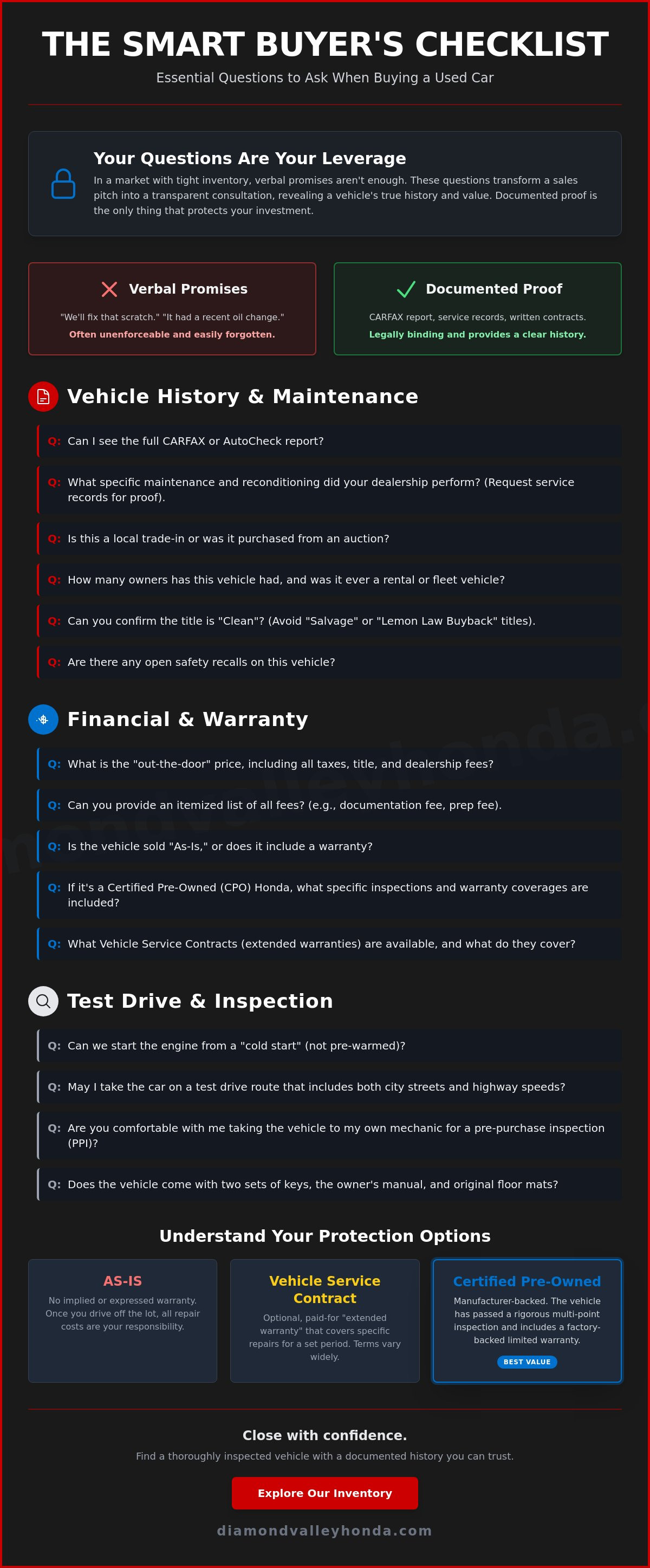
With used car inventory sitting at a tight 43-day supply and prices trending upward this year, a salesperson's verbal promise is the most expensive thing you can take at face value. You deserve more than a "trust me" when you are searching for a reliable commuter to handle Southern California traffic. Knowing the specific questions to ask when buying a used car from a dealer is your only real leverage in 2026. It turns a high-pressure transaction into a transparent conversation rooted in documented proof rather than empty claims.
We understand that the fear of buying a lemon or discovering hidden fees can make the car-buying process feel overwhelming. You want a vehicle that stands the test of time and a dealer that stands behind their inventory. This guide provides a definitive list of 20 questions designed to reveal a vehicle's true history and long-term value. You will learn how to distinguish between as-is units and Certified Pre-Owned Honda vehicles, how to verify maintenance records, and how to clarify the total cost of ownership before you ever sign a contract. Let's get you behind the wheel with total confidence.
Key Takeaways
- Learn how to shift the dynamic of your dealership visit from a standard sales pitch to a professional consultation that puts you in control.
- Discover the specific questions to ask when buying a used car from a dealer to uncover the true "out-the-door" price, including local taxes and documentation fees.
- Identify potential red flags by requesting documented proof of a vehicle's history and maintenance rather than relying on verbal assurances.
- Master the test drive with actionable steps like requesting a "cold start" and coordinating an independent mechanical inspection.
- Understand your protection options by clarifying the differences between "as-is" inventory, Certified Pre-Owned Honda vehicles, and vehicle service contracts.
The Strategy of Inquiry: Why Your Questions Define Your Deal
Walking onto a car lot in Hemet or San Jacinto shouldn't feel like a high-stakes negotiation. Instead, try viewing it as a professional consultation. You are the lead investigator for your next major investment. The specific questions to ask when buying a used car from a dealer do more than just gather data. They signal that you are an informed consumer who understands the current market. This shift in dynamic changes the conversation from a one-sided sales pitch into a collaborative effort to find the right vehicle for your needs.
It's vital to remember that in California, verbal promises are rarely legally binding. If a salesperson tells you they will fix a scratch or provide a second key, but it isn't in the written contract, you have no legal recourse. Your primary goal is to uncover the reconditioning story of the car. Every vehicle in our used vehicle inventory goes through a process before it hits the lot. You want to know exactly what was repaired, replaced, or simply inspected. This transparency ensures you aren't just buying a car, but rather a documented history of care.
The Difference Between Asking and Verifying
Asking a question is only half the battle. Verification is what secures your investment. The history of the used car market shows that documentation is the only true bridge between a buyer and a seller. Always request to see physical or digital service records for any work performed by the dealership. If someone claims the vehicle received new brake pads, the shop order should reflect that. Cross-reference these verbal answers with the Vehicle History Report, such as CARFAX. If you notice a discrepancy between what the salesperson says and what the report shows, ask for clarification immediately. We recommend taking notes during your visit. It helps you keep track of details for later comparison and shows the dealer you are serious about the facts.
Setting the Tone with the Sales Associate
You can ask "tough" questions without being confrontational. At Diamond Valley Honda, we believe in a neighborly approach that builds rapport through honesty. Use a direct but friendly style. For instance, instead of demanding to know what's wrong with a car, ask, "What specific maintenance did your technicians perform to get this car ready for sale?" A transparent dealer will welcome deep questions because they are proud of their inventory and their reconditioning standards. If a dealer seems evasive or tries to brush off your concerns about the total cost of ownership, it might be a sign to look elsewhere. A trustworthy local partner wants you to feel empowered, not overwhelmed, throughout the entire process.
Uncovering the Vehicle's Past: History and Maintenance Questions
Before you fall in love with a specific make or model, you need to look past the fresh wax and tire shine. The real value of a vehicle lies in its history and how well it was maintained by its previous owners. While the FTC's Buyer's Guide provides a solid foundation for understanding your rights, the specific history of the car on the lot requires deeper digging. One of the most vital questions to ask when buying a used car from a dealer is whether they can provide a full, printed CARFAX or AutoCheck report for you to review on the spot.
Don't stop at the accident history. You should also ask if the car was a local trade-in or purchased at a dealer auction. Local trade-ins often come with more predictable service histories, whereas auction vehicles can be more of a mystery. Additionally, ensure you ask about open safety recalls. A responsible dealer will address these before the car is listed, but it's your job to verify that no outstanding safety issues remain unaddressed.
Tracing the Ownership Trail
Ownership history matters just as much as mileage. A single-owner vehicle is typically the "gold standard" because it suggests consistent care, while former rental fleet cars might have seen more aggressive use from multiple drivers. In the Hemet and San Jacinto area, we often prefer local cars over those from the East Coast. While Inland Empire vehicles don't face the rust and salt damage common in colder climates, they do face unique challenges from our intense desert heat. Always verify the title status to ensure it's "clean." Avoid any vehicle labeled as "Salvage" or "Lemon Law Buyback," as these can be nearly impossible to insure or trade in later.
The Reconditioning Report: What the Dealer Fixed
Every car that enters our used vehicle inventory goes through a rigorous inspection. You should ask to see the "Internal Repair Order" to see exactly what the technicians did when the car arrived. In Southern California, the heat is a silent killer for specific components. Ask if the battery was tested and if the cooling hoses were inspected for cracks or leaks. These heat-related issues are often overlooked in generic guides but are critical for local drivers. Finally, get the hard numbers on wear items. Don't settle for "the tires are good." Ask for the specific tire tread depth and the remaining thickness of the brake pads to ensure you won't be facing a maintenance bill three months down the road.
Beyond the Sticker Price: Financial and Warranty Questions
The number on the windshield is rarely the final number you'll see on your contract. Understanding the total cost of ownership is a vital step in your journey toward a reliable vehicle. When you're ready to talk numbers, the specific questions to ask when buying a used car from a dealer should focus on transparency and protection. You need to know exactly what happens if a mechanical issue arises the day after you drive home to San Jacinto or Hemet.
Start by asking if the car is sold "as-is" or if it includes a dealer warranty. According to the FTC guide to buying a used car, dealers must display a Buyers Guide that explains this coverage. If the car is "as-is," you're responsible for all repairs from the moment you leave the lot. However, many vehicles in our inventory offer better protection through manufacturer programs or extended service options.
Decoding the Warranty and CPO Status
Don't let a generic "dealer-certified" label confuse you. There's a massive difference between a lot-specific 30-day powertrain warranty and a true Certified Pre-Owned Honda. A manufacturer-backed CPO vehicle must meet strict age and mileage requirements and pass a comprehensive multi-point inspection. Always ask if the remaining original factory warranty is still transferable to you. For cars outside their factory coverage, inquiring about Vehicle Service Contracts can provide long-term peace of mind against unexpected repair costs.
The Final Calculation: Taxes, Fees, and Credits
Ask for a clear, line-item breakdown of the "out-the-door" price. In California, the law protects you with a cap on documentation fees, currently set at $85. This is significantly lower than the national average, which can exceed $700 in some states. You'll also need to account for the 7.25% state sales tax plus any local district taxes. If you have a trade-in, ask how it affects your tax liability. Most states allow the value of your trade-in to be deducted from the taxable amount of your purchase, which can save you a significant amount of money. If you're feeling unsure about the math, check out our guide on how to finance a car to walk through the process step-by-step.
The Physical Proof: Questions for the Test Drive and Inspection
You have reviewed the history and crunched the numbers, but the true test of any vehicle in a used vehicle inventory happens on the pavement. The physical inspection is where you verify that the car's condition matches its paperwork. One of the most important questions to ask when buying a used car from a dealer is whether you can perform a "cold start." Ask the salesperson to keep the engine off until you arrive. Hearing an engine fire up from a dead stop can reveal issues like worn timing belts or starter motor fatigue that often vanish once the block is warm.
Modern vehicles are rolling computers. You must verify that the infotainment system and safety tech, like blind-spot monitoring or lane-keep assist, are functioning perfectly. Replacing a faulty touchscreen or a sensor can cost thousands of dollars. Take the time to sit in the cabin and test every single electronic feature. Cycle the power seats, roll every window down and up, and check the sunroof for smooth operation. Physical proof beats a verbal "it works" every time.
The Test Drive Interrogation
A 15-minute loop around the block isn't enough to reveal a car's character. You need to push the vehicle to simulate your actual commute. In the Hemet and San Jacinto area, the air conditioning isn't a luxury; it's a survival tool. Crank the AC to its maximum setting to see if it can handle our triple-digit summer days without straining the engine. Take the car onto the freeway to check for vibrations at speeds above 65 mph. If the steering wheel shakes or the car "pulls" to one side, you may be looking at a wheel alignment service or suspension issue. Listen for clunks or rattles when driving over speed bumps or uneven local pavement, as these are early warning signs of worn struts or bushings.
The Independent Inspection Request
Always ask if you can take the vehicle to an independent mechanic for a Pre-Purchase Inspection (PPI). A dealer's response to this request is a major litmus test for their transparency. If a dealer refuses to let an outside professional look at the car, it's usually time to walk away. At Diamond Valley Honda, we encourage this level of scrutiny because we stand behind the quality of our reconditioning process. If your mechanic finds a minor issue, like a worn belt or a battery nearing the end of its life, use that information as a negotiation tool. You can ask the dealer to perform a battery testing and replacement or adjust the price to cover the future repair. Before you commit, browse our current selection to find a vehicle that passes every test with flying colors.
Closing with Confidence at Diamond Valley Honda
You have done the hard work of researching the market and learning the essential questions to ask when buying a used car from a dealer. Now, you need a partner who values that preparation. At Diamond Valley Honda, we don't just tolerate deep inquiries; we encourage them. Our team believes that a well-informed buyer is a happy owner. We've built our reputation in the Inland Empire on transparency, ensuring that every vehicle in our inventory has a clear, documented story. You won't find high-pressure tactics here, only a professional and neighborly environment focused on your needs.
Every used car for sale on our lot undergoes a rigorous inspection by factory-trained technicians. We specifically look for the local issues we've discussed, like heat-stressed batteries and cooling systems, to ensure your commute remains stress-free. Our commitment to transparent pricing means the numbers we discuss are grounded in reality, helping you understand the total cost of ownership before you sign a single document. We want you to feel empowered throughout the entire process.
The Diamond Valley Honda Difference
Being a local partner means we treat you like a neighbor, because you are one. You gain access to our state-of-the-art service center and a team that uses Honda Genuine Parts for all reconditioning and repairs. This personalized care comes from people who live and work in the Hemet area and understand the specific driving conditions we face. Our support continues long after you drive off the lot. Whether you need a simple oil change or complex maintenance years down the road, our team is here to ensure your vehicle stays as reliable as the day you bought it.
Your Next Steps Toward Ownership
Ready to put your knowledge to use? Start by browsing our inventory online to identify the models that fit your lifestyle. Once you've narrowed down your choices, schedule a priority test drive to experience the vehicle firsthand. Bring your list of questions and any necessary paperwork, like your trade-in title or proof of insurance, to ensure a seamless transaction. You have mastered the strategy of inquiry. Now, it's time to finalize your deal with the confidence of an expert buyer and the support of a trusted local partner.
Drive Away with Total Peace of Mind
Mastering the right questions to ask when buying a used car from a dealer transforms your experience from a stressful transaction into a confident investment. You now have the tools to verify a vehicle's history, decode complex warranty terms, and ensure that every electronic feature is ready for the road. By focusing on documented proof rather than verbal promises, you protect both your wallet and your safety. This proactive approach ensures that there are no surprises once you get your new ride home to San Jacinto or Hemet.
At Diamond Valley Honda, we've spent decades building a reputation for honesty and integrity. Our factory-trained technicians perform rigorous inspections on every vehicle, and our 4.5+ star Google rating reflects our commitment to our customers. We've been serving Hemet and the Inland Empire since 1962; we take pride in being a local partner you can trust. Ready to see the difference that transparency makes? Browse Our Transparently Priced Used Inventory in Hemet and find your perfect match today. We look forward to helping you drive away with total confidence.
Common Questions About the Used Car Process
Can I return a used car to a dealer if I change my mind in California?
California law does not provide a standard "cooling-off" period or a statutory right to cancel a used car purchase. Once you sign the contract and take delivery, the sale is final. The only exception is if you choose to purchase a "Contract Cancellation Option Agreement" at the time of sale. This optional agreement allows you to return the vehicle within a specific timeframe, usually two days, provided you stay within certain mileage limits and return the car in its original condition.
What is a 'Buyers Guide' and why is it on the window?
The Buyers Guide is a mandatory federal document required by the FTC to be displayed on every used vehicle sold by a dealer. It clearly discloses whether the car is being sold "as-is" or with a specific dealer warranty. This document is part of your sales contract and overrides any verbal promises made during the negotiation. It also lists the major systems of the car and potential defects you should look for, serving as a transparent baseline for your protection.
Is it better to finance through the dealer or a credit union?
The best choice depends on the specific annual percentage rate (APR) and terms you qualify for based on your credit profile. Credit unions often offer low rates for their members, but dealerships have access to a vast network of lending partners and manufacturer-backed incentives that can sometimes beat a bank's offer. We recommend getting a pre-approval from your local credit union first. This gives you a solid benchmark to compare against the dealership's financing options to ensure you get the most affordable monthly payment.
How do I know if the mileage on a used car is accurate?
You can verify mileage by comparing the current odometer reading against the service records found in a Vehicle History Report. Look for a logical, chronological progression of miles at each service interval. Physical indicators like heavy wear on the rubber brake pedal or a frayed driver's seatbelt can also signal a car has more miles than the odometer shows. These are essential questions to ask when buying a used car from a dealer to ensure you aren't paying for a vehicle with a tampered history.
What are the most common 'hidden fees' at a used car dealership?
Common fees include the documentation fee, sales tax, and vehicle registration costs. In California, the documentation fee is capped by law at $85, which is a significant benefit for local buyers. Be on the lookout for "add-on" fees for products like window etching or interior protection packages that weren't part of the advertised price. Always ask for a line-item breakdown of the "out-the-door" price early in the conversation so you can see exactly where every dollar is going.
Should I buy a used car that has been in a minor accident?
A minor accident isn't always a reason to walk away if the repairs were performed correctly and the price reflects the history. These vehicles can actually offer excellent value for budget-conscious buyers in Hemet. However, you must verify the quality of the work. Asking the right questions to ask when buying a used car from a dealer about the specific nature of the damage and requesting an independent inspection will help you confirm that the safety systems and frame remain fully intact.
What documents should I receive after buying a used car?
You should receive a signed Bill of Sale, the retail installment contract if you financed, and a copy of the odometer disclosure statement. You will also need the temporary registration permit and a copy of the signed Buyers Guide from the window. If you decided to invest in a Vehicle Service Contract or purchased a Certified Pre-Owned model, make sure you have the specific coverage documents and terms of the agreement before you leave the lot.
How much can I realistically negotiate on a used car price?
Negotiation margins are currently tighter than in previous years because used car inventory is at a low 43-day supply. Most dealers use real-time market data to price their cars competitively from the start to attract interest. Instead of focusing solely on a round number, try negotiating the "out-the-door" price or asking for specific maintenance items to be addressed. If a car needs new tires or a battery testing and replacement, those documented needs provide a professional basis for a price adjustment.