Imagine it's 3:00 PM on a Tuesday in July, and the thermometer outside your Hemet home hits 104 degrees. You turn the key in your Honda, but instead of the engine's familiar purr, you hear a sluggish click. We know there's nothing more stressful than being stuck in the Inland Empire heat, which is why we prioritize fast and accurate Battery Testing and Replacement. It's frustrating to face confusing warranty terms or wonder if a retail clerk is just trying to hit a sales quota while you're stranded.
You deserve an honest assessment of your vehicle's health from your hometown team. At Diamond Valley Honda, our service focuses on technical accuracy rather than high-pressure sales tactics. We'll show you how the triple-digit temperatures in Southern California can shorten a battery's life by 50% compared to more temperate climates. This guide explains why our certified technicians provide a reliable diagnosis and how our genuine Honda replacements keep you moving with a nationwide warranty for total peace of mind.
Key Takeaways
- Understand how the intense Hemet heat acts as a "silent killer" for your battery and how to prevent unexpected failure during the first cold snap.
- Discover why professional Battery Testing and Replacement at Diamond Valley Honda offers a more comprehensive evaluation than standard retail guesswork.
- Learn the benefits of installing a Honda Genuine Battery, including the long-term peace of mind provided by an available 100-month limited warranty.
- Identify the critical warning signs of a weak battery, from the "slow crank" to minor electrical glitches, before they become major problems.
- See how our factory-trained experts combine world-class Honda engineering with the personalized, neighborly service you expect in the Inland Empire.
Why Hemet Heat is Your Car Battery’s Worst Enemy
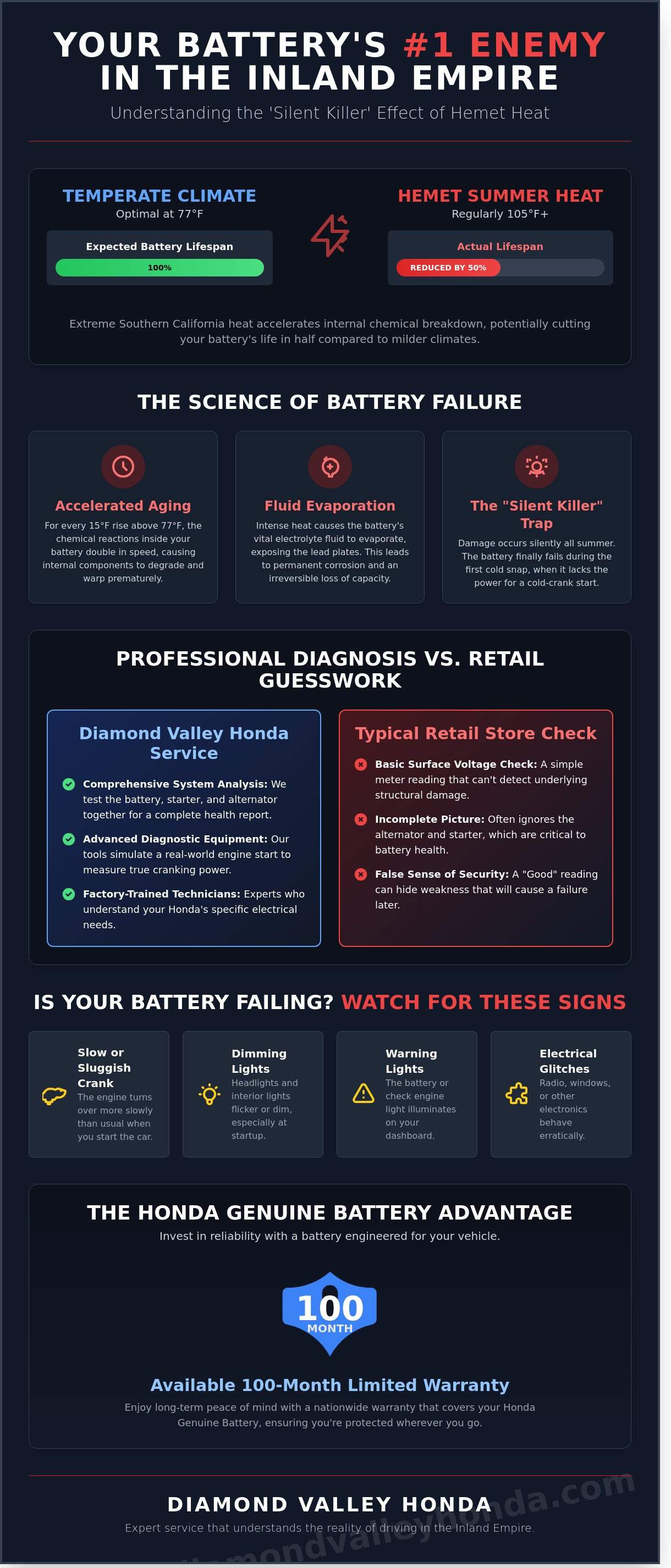
Living in the Inland Empire means dealing with summer temperatures that regularly climb above 105°F. While most drivers worry about their tires or cooling systems, your automotive battery is often the first component to suffer. Heat is a relentless catalyst for chemical breakdown. Inside a standard lead-acid battery, the chemical reactions that store energy are designed to operate optimally at 77°F. When Hemet temperatures spike, these reactions accelerate beyond their intended limits, causing the internal components to degrade at double the normal rate for every 15-degree increase in temperature.
Many local drivers fall victim to the "silent killer" effect. During the peak of a Riverside County summer, your battery might seem to function perfectly because heat actually lowers the internal resistance, making it easier for the battery to turn the engine over. However, that same heat is physically warping the internal lead plates and shedding active material. You won't notice the damage until the first cold snap hits San Jacinto in November. When the temperature finally drops, the chemical reaction slows down, and the damaged battery can no longer provide the necessary cold cranking amps to start your Honda. Proactive Battery Testing and Replacement is the only way to catch this hidden damage before you're stranded in a parking lot.
The Science of Heat and Battery Evaporation
Extreme heat causes the liquid electrolyte solution inside your battery to evaporate. This is particularly problematic in Hemet, where 110°F days are 40% more taxing on your electrical system than a standard 75°F afternoon. As fluid levels drop, the tops of the lead plates are exposed to air, leading to permanent corrosion and a permanent loss of capacity. Thermal runaway is a condition where a damaged battery generates more heat during charging than it can dissipate, triggering a self-sustaining cycle of rising temperatures that leads to total internal failure in 2026 automotive power systems. This process turns a reliable power source into a liability that can fail without a moment's notice.
Local Driving Habits in Riverside County
Your daily routine in the Hemet Valley directly impacts how long your battery lasts. Short, three-mile trips to the Hemet Valley Mall or local grocery stores are surprisingly hard on your vehicle. Every time you start your engine, the battery loses a significant amount of charge. It takes miles of continuous driving for the alternator to replenish that energy. If your commute consists mostly of stop-and-go traffic on the CA-74 or CA-79, your battery rarely reaches a full state of charge.
- Short trips prevent the alternator from completing a full recharge cycle.
- High electrical loads from air conditioning and ventilated seats put extra strain on a weakened battery.
- Frequent idling in San Jacinto traffic causes heat to soak into the engine bay, further cooking the battery.
Choosing Diamond Valley Honda means working with a team that understands these specific local stressors. Our "Hometown Honda" care is built on the reality of driving in Southern California. We don't just look at a generic chart; we evaluate your battery based on the intense climate and driving patterns unique to our community. Regular Battery Testing and Replacement at our service center ensures that your Honda remains dependable, regardless of how high the thermometer climbs. We prioritize transparency and provide clear data on your battery's health so you can make informed decisions for your vehicle's longevity.
Professional Battery Testing vs. Retail Guesswork
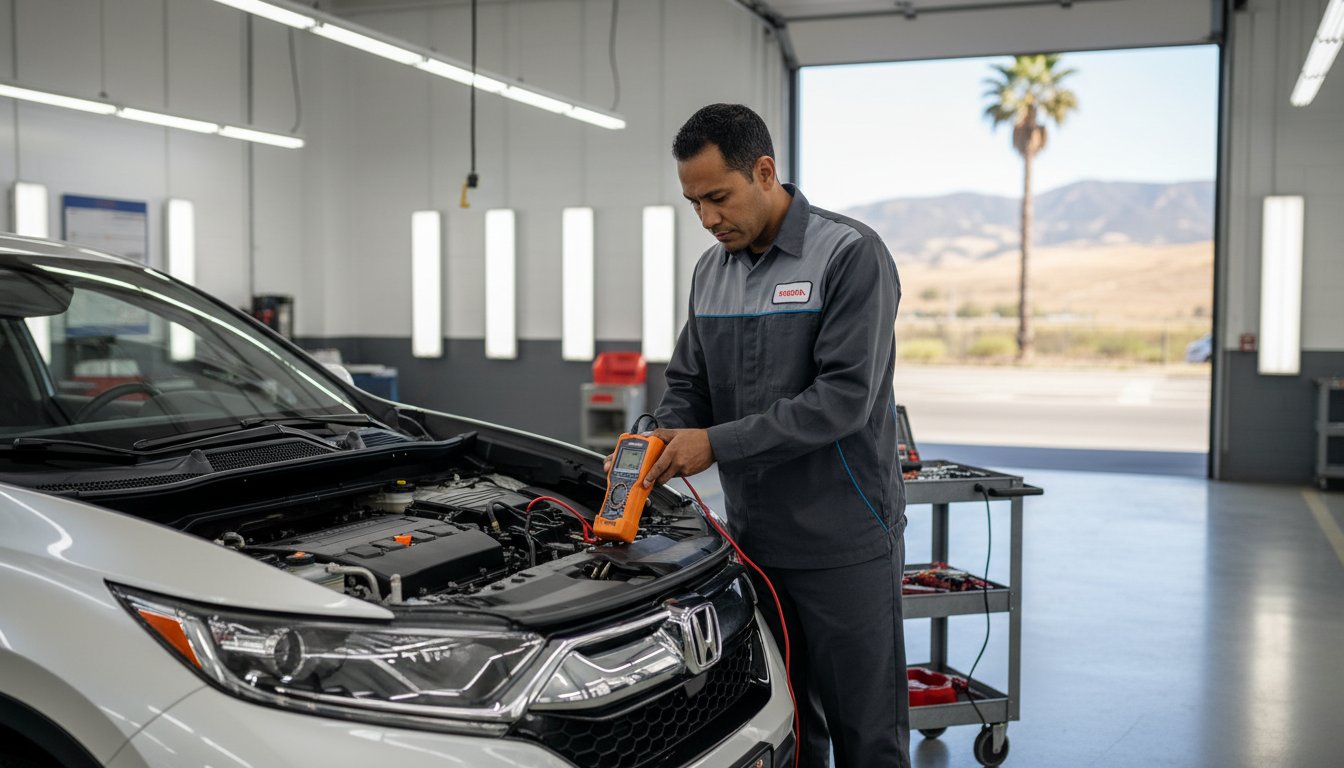
Most drivers in Hemet have experienced the frustration of a car that won't start. You might head to a local retail chain for a free check, but those basic handheld testers often provide an incomplete picture. A retail clerk usually hooks up a device that measures surface voltage and internal resistance in about 30 seconds. This method ignores the complex relationship between your battery and the rest of your vehicle's electrical system. Professional Battery Testing and Replacement at Diamond Valley Honda involves a holistic evaluation of the entire starting and charging circuit. Our technicians use advanced diagnostic equipment that simulates real-world cranking loads to ensure your battery can actually perform when you need it most.
Relying on a retail "Good" reading can lead to a false sense of security. A battery might show 12.6 volts on a simple meter but lack the structural integrity to deliver the high amperage required during summer's sizzling extremes in the San Jacinto Valley. High temperatures accelerate chemical degradation inside the casing. We often see batteries that test well at a retail counter but fail under the 200-amp draw of a Honda starter motor. Beyond the battery itself, our team inspects terminal tension and removes corrosive buildup. A loose terminal or a thin layer of oxidation can block power flow just as effectively as a dead cell.
The Role of the Alternator and Starter
A new battery won't solve your problems if your alternator is failing to provide a steady 13.8 to 14.2 volts of charging power. If our technicians find a parasitic draw, which is an electrical component staying on after you park, your new battery will likely die within 72 hours. Our multi-point inspection process at Diamond Valley Honda examines the starter's current draw and the alternator's output under load. We provide this comprehensive level of care to drivers from Murrieta, Temecula, and Menifee to ensure they don't get stranded. You can schedule a diagnostic visit to get a clear picture of your vehicle's electrical health.
State of Health (SOH) vs. State of Charge (SOC)
Understanding the difference between State of Charge and State of Health is vital for long-term reliability. State of Charge (SOC) tells us if the battery is currently "full" or "empty," much like a fuel gauge. State of Health (SOH) measures the battery's ability to hold that charge and deliver power over time. A battery at 12.2 volts is actually 50% discharged, and while a charger might bring the voltage back up, it won't fix internal plate damage. Cold Cranking Amps (CCA) are the muscle behind your engine's start; they represent the amount of current a battery can provide for 30 seconds at 0 degrees Fahrenheit. Even in Hemet's milder winters, a battery with low SOH will struggle to turn over a cold engine because the chemical reaction inside the lead-acid cells slows down significantly.
The Benefits of Honda Genuine Batteries in the Inland Empire
Your Honda is a complex machine where every component works in harmony. When you visit us for Battery Testing and Replacement, we don't just swap out a plastic box. We install a Honda Genuine Battery specifically engineered for your vehicle's unique electrical architecture. Unlike generic brands, these batteries meet the exact Cold Cranking Amps (CCA) and Reserve Capacity requirements your engine needs to start reliably during a Hemet summer where temperatures frequently exceed 105 degrees. We provide a 100-month limited warranty on these replacement batteries, giving you peace of mind for over eight years.
Modern Honda models rely on sophisticated electronics like the Honda Sensing® suite. These safety systems, including Collision Mitigation Braking and Lane Keeping Assist, require consistent voltage levels to function accurately. A weak or inconsistent power source can trigger "ghost" warning lights or cause these systems to lag. Scientific data on how heat affects car battery life shows that high temperatures accelerate grid corrosion and fluid loss. By choosing a battery designed for your car's specific charging system, you ensure these vital safety features remain active and dependable on every trip through the San Jacinto Valley.
OEM vs. Aftermarket: What’s the Real Difference?
The "Diamond Valley Difference" centers on quality components. Many retail "one size fits all" batteries use thinner internal lead plates and weaker grid construction to save on manufacturing costs. These bargain options often fail shortly after their 12-month warranties expire. In contrast, Honda Genuine Batteries feature reinforced internal grids that resist the heavy vibrations common when driving on local routes like Highway 74. Your investment is protected by a nationwide warranty, meaning you can get support at any of the 1,000+ Honda dealerships across the United States if an issue arises.
Proper Disposal and Environmental Responsibility
We take our role as a local business in Riverside County seriously. Lead-acid batteries contain toxic materials that require professional handling to prevent soil and water contamination. When we perform a Battery Testing and Replacement, we manage the entire recycling process for you. Here is how we protect our local environment:
- Core Charge Management: We apply a core charge to every new battery, which acts as a financial incentive to ensure the old unit returns to a certified recycling facility rather than a landfill.
- Closed-Loop Recycling: Roughly 99 percent of a lead-acid battery is recyclable. We partner with specialized handlers who reclaim the lead and plastic for use in new products.
- Local Preservation: By following strict disposal protocols, we help keep the Hemet and San Jacinto groundwater supplies clean for our neighbors and future generations.
Choosing Diamond Valley Honda means you're opting for a transparent, professional experience. We don't use high-pressure tactics. Instead, we provide the technical data you need to make a smart decision for your vehicle's longevity. Our service team stays focused on getting you back on the road with a dependable power source that's built to last.
When to Replace Your Battery: Signs and Symptoms
A battery rarely dies without warning. Your Honda usually drops hints before it leaves you stranded at the Hemet Valley Mall or on a commute down State Street. One of the most common red flags is the "slow crank." If your engine takes an extra 2 or 3 seconds to turn over, the battery's cold cranking amps (CCA) are likely dropping below the required threshold. This delay means the battery can't provide the surge of energy needed to spin the starter motor at full speed. When that ignition sound changes from a crisp roar to a labored groan, your battery is on its last legs.
You might also notice electrical "gremlins" affecting your cabin experience. Modern Hondas rely on stable voltage to power everything from the 9-inch touchscreen to the power windows and advanced safety sensors. If your interior lights flicker when you idle at a stoplight or your windows crawl up slower than usual, your battery is struggling to maintain a consistent 12.6-volt charge. Pay close attention to the dashboard. A "Check Engine" or "Battery" light indicates the charging system detected a voltage drop that could compromise your vehicle's electronics. These systems are sensitive, and even a minor dip in power can trigger false error codes.
Physical inspection is just as vital as listening to the engine. Pop the hood once a month to look for deformities. A battery case that looks bloated or "swollen" has likely suffered from overcharging or extreme heat exposure. You should also look for heavy white or blue powdery corrosion on the terminals. This acidic buildup blocks the flow of electricity between the battery and the rest of the car. If you see these signs, it's time to visit us for professional Battery Testing and Replacement before the internal lead plates fail completely.
The Age Factor: The 3-Year Rule
In Southern California, batteries face a unique challenge. While batteries in cooler climates might last 5 or 6 years, the triple-digit heat in the Inland Empire accelerates internal chemical evaporation. Most batteries in Hemet rarely last beyond 3 to 4 years. If you live in Menifee or Perris and purchased your vehicle before 2023, it's time to check your service records. You can find the manufacture date on a small circular sticker or a heat-stamped code on the top of the battery case. A code like "05/21" means your battery was made in May 2021 and is already entering the danger zone for our local climate.
The "Clicking" Sound and What It Means
When you turn the key and hear a rapid-fire clicking sound, you're hearing the starter solenoid engaging and disengaging rapidly. This happens because there's enough power to move the solenoid but not enough amperage to actually turn the heavy starter motor. It's a clear sign of a dead battery rather than a failed starter, which usually results in a single loud "clunk" or total silence. If you need to jump-start your modern Honda, always connect the positive cable first and ensure the donor vehicle stays running. To protect the Engine Control Unit (ECU), don't let the two vehicles touch, as a sudden voltage spike can damage sensitive computer chips that cost thousands to replace.
Don't wait for the clicking sound to ruin your morning schedule. You can schedule professional Battery Testing and Replacement at Diamond Valley Honda today to ensure your vehicle stays dependable for years to come.
Expert Battery Service at Diamond Valley Honda
Choosing a service center shouldn't feel like a chore. At Diamond Valley Honda, we've built a reputation as a trusted local partner for drivers across the Inland Empire. Whether you're coming from Banning or Beaumont, our team provides the expert care your vehicle deserves without the high-pressure sales tactics found elsewhere. Our facility is designed to respect your schedule and your comfort from the moment you pull into our service drive.
Our service center offers a modern waiting lounge where you can relax or catch up on work. We provide complimentary high-speed Wi-Fi and premium coffee to make your visit as pleasant as possible. Our factory-trained technicians bring years of specialized experience to every Battery Testing and Replacement job. They understand the specific electrical requirements of your Honda model, from the fuel-efficient Civic to the rugged Passport. This expertise ensures that we identify potential issues before they leave you stranded on Highway 74 or the 215 freeway.
Scheduling an appointment is straightforward and takes less than two minutes. You can use our intuitive online scheduling tool or speak directly with our service coordinators at (951) 374-3317. We offer flexible time slots starting as early as 7:00 AM to accommodate your morning commute. Our goal is to provide a seamless experience that gets you back to your life in Lake Elsinore or San Jacinto with total confidence in your vehicle's reliability.
The Diamond Valley Difference in Service
We believe in total transparency. You'll receive a detailed report after your Battery Testing and Replacement diagnostic, explaining exactly why a service is or isn't recommended. We exclusively use Genuine Honda Parts for every job. These components are engineered specifically for your car and often include a 100 month limited warranty for added peace of mind. You won't find generic, one-size-fits-all solutions here. Take the first step toward a worry-free drive and schedule your battery test today with our professional team.
Serving the Inland Empire Community
Diamond Valley Honda is more than just a business; we're a part of the Riverside County fabric. For over 15 years, we've supported local high school athletics and participated in annual Hemet community festivals. We serve drivers from San Jacinto to Lake Elsinore with the same integrity we'd show our own family. We know the local climate and how the 100 degree summer heat affects your vehicle's longevity. Visit Diamond Valley Honda for your next service and see why our neighbors trust us with their vehicles year after year.
Drive Confidently Through the Inland Empire Heat
Don't let the Hemet sun leave you stranded with a dead engine. Intense temperatures in Riverside County can significantly shorten your battery's lifespan, making proactive care essential for every driver. Choosing professional Battery Testing and Replacement at Diamond Valley Honda removes the guesswork often found at big-box retail stores. Our factory-trained Honda technicians provide precise diagnostics to ensure your vehicle remains dependable through every season and every commute.
Investing in a Genuine Honda Battery means you're protected by a 100-month limited warranty, offering a level of security that generic alternatives simply can't match. As a top-rated service center in Riverside County, we pride ourselves on delivering transparent, expert care that respects your time and your budget. It's about more than just a quick fix; it's about maintaining the long-term health of your vehicle with parts designed specifically for your model. We're here to make sure your car starts every single time you turn the key.
Schedule Your Honda Battery Service in Hemet Now to experience the Diamond Valley difference. We look forward to seeing you at the dealership soon.
Frequently Asked Questions
How long does a car battery typically last in Hemet, CA?
Most car batteries in Hemet last between 3 and 4 years because our triple-digit summer temperatures accelerate internal corrosion. Excessive heat causes vital battery fluids to evaporate faster than they would in cooler coastal climates. We recommend professional battery testing and replacement every 36 months to ensure your Honda stays reliable on the 74 or 79 highways.
Is battery testing free at Diamond Valley Honda?
Yes, we provide a complimentary battery test as a standard part of every multi-point inspection at our service center. Our technicians use specialized diagnostic tools to measure your battery's cold cranking amps and overall health. You'll receive a printed report showing exactly how much life remains, giving you total peace of mind before you head out on a long trip.
Can I replace my own Honda battery, or should a professional do it?
You can replace your own battery, but professional installation is safer for modern Honda models built after 2018. These newer vehicles use sophisticated battery management systems that require a digital reset to ensure the alternator charges the new unit correctly. Our certified technicians handle the heavy lifting and recycle your old lead-acid battery according to California environmental standards.
What is the difference between a battery test and a charging system test?
A battery test measures the energy storage capacity of the unit itself, while a charging system test evaluates the alternator's ability to provide power and recharge that battery. If your battery is 100 percent healthy but the alternator fails, your car won't start. We check the drive belts, cables, and alternator output to ensure the entire electrical loop functions perfectly.
Does a new Honda battery come with a warranty?
Every Genuine Honda replacement battery we install features a 100 month limited warranty for your protection. This includes 36 months of 100 percent replacement coverage for parts and labor, followed by a pro-rated period for the remaining 64 months. It's a dependable way to protect your investment and ensure you aren't left stranded in the Southern California sun.
Why does my car battery die so often in the summer?
High temperatures in Hemet often exceed 100 degrees in August, which causes battery fluid to evaporate and internal components to corrode 20 percent faster. Heat is actually a much bigger threat to battery longevity than winter cold is. Regular battery testing and replacement prevents these chemical breakdowns from turning into a dead car in a grocery store parking lot.
How much does a Honda battery replacement cost in 2026?
In 2026, a standard Honda battery replacement typically ranges from $189 to $325 depending on whether your vehicle requires a traditional lead-acid or an Advanced Glass Mat unit. This price includes the Genuine Honda battery, professional installation, and the disposal of your old core. We always provide a transparent quote upfront so there are no surprises when you visit our service desk.
Do I need an appointment for a battery test at your Hemet service center?
You don't need a formal appointment for a quick battery test thanks to our Honda Express Service lane. We designed this lane to get you in and out of the dealership in under 30 minutes. If you prefer a specific time, you can schedule online to ensure a dedicated technician is ready to assist you the moment you arrive at our Hemet location.